


Page 236 - MODERN ELECTROCHEMISTRY
P. 236
172  CHAPTER 2


           or:


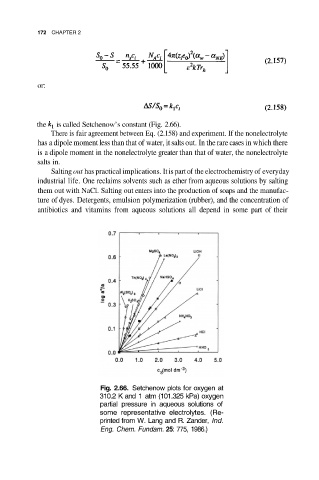
           the  is called Setchenow’s constant (Fig. 2.66).
               There is fair agreement between Eq. (2.158) and experiment. If the nonelectrolyte
           has a dipole moment less than that of water, it salts out. In the rare cases in which there
           is a dipole moment in the nonelectrolyte greater than that of water, the nonelectrolyte
           salts in.
               Salting out has practical implications. It is partof the electrochemistry of everyday
           industrial life. One reclaims solvents such as ether from aqueous solutions by salting
           them out with NaCl. Salting out enters into the production of soaps and the manufac-
           ture of dyes. Detergents, emulsion polymerization (rubber), and the concentration of
           antibiotics and  vitamins from  aqueous solutions  all depend in  some part of their


                            Fig. 2.66. Setchenow plots for oxygen at
                            310.2 K and 1 atm (101.325 kPa) oxygen
                            partial pressure  in  aqueous  solutions of
                            some representative  electrolytes. (Re-
                            printed from W. Lang and R. Zander, Ind.
                            Eng. Chem. Fundam. 25: 775, 1986.)

