


Page 161 - Modern physical chemistry
P. 161
1.10 Partial Molar Gibbs Energy                 153

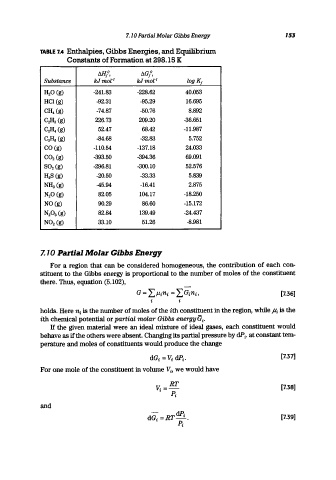
             TABLE 7.4  Enthalpies, Gibbs Energies, and Equilibrium
                     Constants of Formation at 298.16 K

                               Ml/,        6G/,
              Substance      kJmo[-I      kJ mol- I      logK f

              H 20  (g)      -241.83      -228.62        40.053
              HCl(g)          -92.31       -95.29        16.695
              CH 4  (g)       -74.87       -50.76         8.892
              C 2H 2  (g)     226.73       209.20       -36.651
              C 2H 4  (g)      52.47        68.42       -11.987
              C 21ia (g)      -84.68       -32.83         5.752
              CO (g)         -110.54      -137.18        24.033
              CO 2  (g)      -393.50      -394.36        69.091
              802 (g)        -296.81      -300.10        52.576
              H 28 (g)        -20.50       -33.33         5.839
              NHa (g)         -45.94       -16.41         2.875
              N 20  (g)        82.05       104.17       -18.250
              NO (g)           90.29        86.60       -15.172
              N 20 a  (g)      82.84       139.49       -24.437
              N0 2  (g)        33.10        51.26        -8.981


             Z 10 Partial Molar Gibbs Energy
                For a region that can be considered homogeneous,  the contribution of each con-
             stituent to the Gibbs energy is proportional to the number of moles of the constituent
             there. Thus, equation (5.102),
                                          G = L,uini = LGini,                        [7.36]
                                              i        i
             holds. Here n i  is the number of moles of the ith constituent in the region, while i4 is the
             ith chemical potential or partial molar Gibbs energyG i •
                If the given material were an ideal mixture of ideal gases, each constituent would
             behave as if the others were absent. Changing its partial pressure by dP i • at constant tem-
             perature and moles of constituents would produce the change
                                                                                     [7.37]
                                              dGi  = Vi  dP i ·
             For one mole of the constituent in volume Vi' we would have


                                                                                     [7.38]

             and

                                                                                     [7.39]

