


Page 159 - Modern physical chemistry
P. 159
7.9 Key Thermodynamic Properties                 151

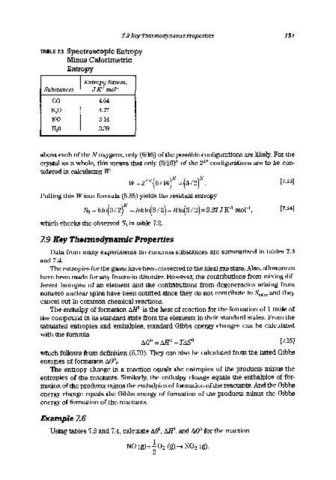
             TABLE 7.2  Spectroscopic Entropy
                     Minus Calorimetric
                     Entropy

                          Entropy Excess,
              Substances     J Ki mot i
                 CO            4.64
                 N 20          4.77
                 NO            3.14
                 H2O           3.39


             about each of the N oxygens, only (6/16) of the possible configurations are likely. For the
             crystal as a whole, this means that only (6/16)N of the 22N configurations are to be con-
             sidered in calculating W:

                                        W = 22N(6/16t =(3/2t.                        [7.33)
             Putting this W into formula (5.55) yields the residual entropy
                                                                       I
                          So =kln(3/2t =.Nkln(3/2) = Rln(3/2) = 3.37 JK- mol-I,      [7.34}
             which checks the observed So in table 7.2.

             Z9 Key Thermodynamic Properties
                Data from many experiments on common substances are summarized in tables 7.3
             and 7.4.
                The entropies for the gases have been corrected to the ideal gas state. Also, allowances
             have been made for any frozen-in disorder. However, the contributions from mixing dif-
             ferent isotopes of an element and the contributions from degeneracies arising from
             nonzero nuclear spins have been omitted since they do not contribute to Scalor and they
             cancel out in common chemical reactions.
                The enthalpy of formation tllflf is the heat of reaction for the formation of 1 mole of
             the compound in its standard state from the elements in their standard states. From the
             tabulated entropies and enthalpies, standard Gibbs energy changes can be calculated
             with the formula
                                                                                     [7.35}
             which follows from definition (5.79). They can also be calculated from the listed Gibbs
             energies of formation tlGo f.
                The entropy change in a  reaction equals the entropies of the products minus the
             entropies of the reactants. Similarly, the enthalpy change equals the enthalpies of for-
             mation of the products minus the enthalpies of formation of the reactants. And the Gibbs
             energy change equals the Gibbs energy of formation of the products minus the Gibbs
             energy of formation of the reactants.

             ExampleZ6
                Using tables 7.3 and 7.4, calculate ~, tllfl, and !J.Go for the reaction

                                       NO (g) +.! O 2  (g) ~ N0 2  (g).
                                               2

