


Page 218 - Modular design for machine tools
P. 218
178   Engineering Design for Machine Tool Joints


                     0.55

                     0.50

                 A n  A n +1  0.45
                  2l n  0.40    n = 200 rev/min  100
                  Damping factor ψ =  0.35  5
                                   50


                     0.30

                     0.25
                                        Nonrotating
                     0.20

                     0.15
                         0    4   8    12   16   20   24  1 mm
                                    Vibration amplitude, mm
                                Overhang of boring spindle: 300 mm
                                Continuous line: Nonloading
                                Broken line: Under load of  20 kgf
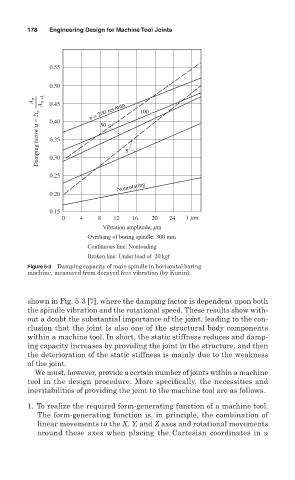
               Figure 5-3 Damping capacity of main spindle in horizontal boring
               machine, measured from decayed free vibration (by Kunin).


               shown in Fig. 5-3 [7], where the damping factor is dependent upon both
               the spindle vibration and the rotational speed. These results show with-
               out a doubt the substantial importance of the joint, leading to the con-
               clusion that the joint is also one of the structural body components
               within a machine tool. In short, the static stiffness reduces and damp-
               ing capacity increases by providing the joint in the structure, and then
               the deterioration of the static stiffness is mainly due to the weakness
               of the joint.
                 We must, however, provide a certain number of joints within a machine
               tool in the design procedure. More specifically, the necessities and
               inevitabilities of providing the joint to the machine tool are as follows.

               1. To realize the required  form-generating function of a machine tool.
                  The form-generating function is, in principle, the combination of
                  linear movements to the X, Y, and Z axes and rotational movements
                  around these axes when placing the Cartesian coordinates in a

