


Page 220 - Modular design for machine tools
P. 220
180   Engineering Design for Machine Tool Joints

                                                   Stationary joint
                                                   between spindlehead
                                                   body and quill

                                      Taper connection


                                                                        Taper
                                                                        connection
                                                                        with tool
                                                                        shank


                          Press-fitted joint
                          of stepped sleeve  Stationary joint  Rolling joint between
                                         between outer race  roller and race
                                         of bearing and quill
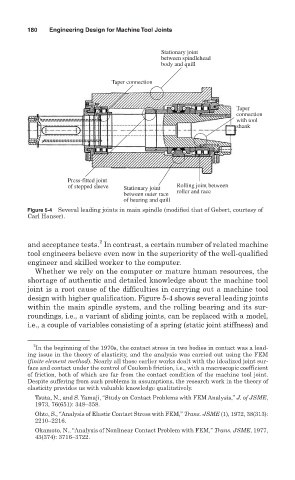
               Figure 5-4 Several leading joints in main spindle (modified that of Gebert, courtesy of
               Carl Hanser).


                                   2
               and acceptance tests. In contrast, a certain number of related machine
               tool engineers believe even now in the superiority of the well-qualified
               engineer and skilled worker to the computer.
                 Whether we rely on the computer or mature human resources, the
               shortage of authentic and detailed knowledge about the machine tool
               joint is a root cause of the difficulties in carrying out a machine tool
               design with higher qualification. Figure 5-4 shows several leading joints
               within the main spindle system, and the rolling bearing and its sur-
               roundings, i.e., a variant of sliding joints, can be replaced with a model,
               i.e., a couple of variables consisting of a spring (static joint stiffness) and


                 2
                  In the beginning of the 1970s, the contact stress in two bodies in contact was a lead-
               ing issue in the theory of elasticity, and the analysis was carried out using the FEM
               (finite element method). Nearly all those earlier works dealt with the idealized joint sur-
               face and contact under the control of Coulomb friction, i.e., with a macroscopic coefficient
               of friction, both of which are far from the contact condition of the machine tool joint.
               Despite suffering from such problems in assumptions, the research work in the theory of
               elasticity provides us with valuable knowledge qualitatively.
                 Tsuta, N., and S. Yamaji, “Study on Contact Problems with FEM Analysis,” J. of JSME,
                 1973, 76(651): 348–358.
                 Ohte, S., “Analysis of Elastic Contact Stress with FEM,” Trans. JSME (1), 1972, 38(313):
                 2210–2216.
                 Okamoto, N., “Analysis of Nonlinear Contact Problem with FEM,” Trans. JSME, 1977,
                 43(374): 3716–3722.

