


Page 223 - Modular design for machine tools
P. 223
Basic Knowledge of Machine Tool Joints        183


                           Column                     Column
               Guide key
                                     Connecting      Taper pin
                                       bolt


                   Base

                                                 Base
                          (a)                          (b)
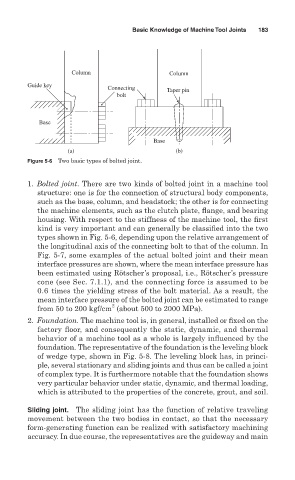
               Figure 5-6 Two basic types of bolted joint.

               1. Bolted joint. There are two kinds of bolted joint in a machine tool
                  structure: one is for the connection of structural body components,
                  such as the base, column, and headstock; the other is for connecting
                  the machine elements, such as the clutch plate, flange, and bearing
                  housing. With respect to the stiffness of the machine tool, the first
                  kind is very important and can generally be classified into the two
                  types shown in Fig. 5-6, depending upon the relative arrangement of
                  the longitudinal axis of the connecting bolt to that of the column. In
                  Fig. 5-7, some examples of the actual bolted joint and their mean
                  interface pressures are shown, where the mean interface pressure has
                  been estimated using Rötscher’s proposal, i.e., Rötscher’s pressure
                  cone (see Sec. 7.1.1), and the connecting force is assumed to be
                  0.6 times the yielding stress of the bolt material. As a result, the
                  mean interface pressure of the bolted joint can be estimated to range
                                      2
                  from 50 to 200 kgf/cm (about 500 to 2000 MPa).
               2. Foundation. The machine tool is, in general, installed or fixed on the
                  factory floor, and consequently the static, dynamic, and thermal
                  behavior of a machine tool as a whole is largely influenced by the
                  foundation. The representative of the foundation is the leveling block
                  of wedge type, shown in Fig. 5-8. The leveling block has, in princi-
                  ple, several stationary and sliding joints and thus can be called a joint
                  of complex type. It is furthermore notable that the foundation shows
                  very particular behavior under static, dynamic, and thermal loading,
                  which is attributed to the properties of the concrete, grout, and soil.

               Sliding joint.  The sliding joint has the function of relative traveling
               movement between the two bodies in contact, so that the necessary
               form-generating function can be realized with satisfactory machining
               accuracy. In due course, the representatives are the guideway and main

