


Page 227 - Modular design for machine tools
P. 227
Basic Knowledge of Machine Tool Joints        187

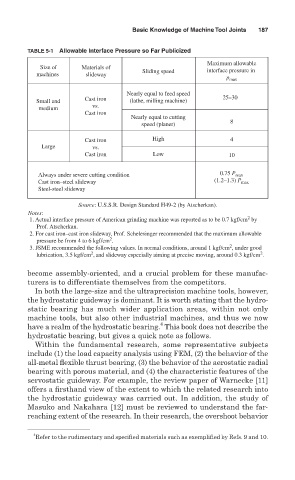
               TABLE 5-1 Allowable Interface Pressure so Far Publicized
                                                                Maximum allowable
                   Size of    Materials of
                                              Sliding speed     interface pressure in
                  machines     slideway
                                                                     p max
                                          Nearly equal to feed speed
                               Cast iron                            25–30
                  Small and                (lathe, milling machine)
                  medium         vs.
                               Cast iron
                                           Nearly equal to cutting
                                              speed (planer)          8
                               Cast iron         High                 4
                   Large         vs.
                               Cast iron         Low                  10

                  Always under severe cutting condition            0.75 P max
                  Cast iron–steel slideway                        (1.2–1.3) P max
                  Steel-steel slideway
                             Source: U.S.S.R. Design Standard H49-2 (by Atscherkan).
                Notes:
                                                                           2
                 1. Actual interface pressure of American grinding machine was reported as to be 0.7 kgf/cm  by
                  Prof. Atscherkan.
                 2. For cast iron–cast iron slideway, Prof. Schelesinger recommended that the maximum allowable
                                      2
                   pressure be from 4 to 6 kgf/cm .
                                                                      2
                 3. JSME recommended the following values. In normal conditions, around 1 kgf/cm , under good
                                                                              2
                                2
                   lubrication, 3.5 kgf/cm , and slideway especially aiming at precise moving, around 0.3 kgf/cm .
               become  assembly-oriented, and a crucial problem for these manufac-
               turers is to differentiate themselves from the competitors.
                 In both the  large-size and the ultraprecision machine tools, however,
               the hydrostatic guideway is dominant. It is worth stating that the hydro-
               static bearing has much wider application areas, within not only
               machine tools, but also other industrial machines, and thus we now
                                                   4
               have a realm of the hydrostatic bearing. This book does not describe the
               hydrostatic bearing, but gives a quick note as follows.
                 Within the fundamental research, some representative subjects
               include (1) the load capacity analysis using FEM, (2) the behavior of the
               all-metal flexible thrust bearing, (3) the behavior of the aerostatic radial
               bearing with porous material, and (4) the characteristic features of the
               servostatic guideway. For example, the review paper of Warnecke [11]
               offers a firsthand view of the extent to which the related research into
               the hydrostatic guideway was carried out. In addition, the study of
               Masuko and Nakahara [12] must be reviewed to understand the  far-
               reaching extent of the research. In their research, the overshoot behavior

                 4
                  Refer to the rudimentary and specified materials such as exemplified by Refs. 9 and 10.

