


Page 225 - Modular design for machine tools
P. 225
Basic Knowledge of Machine Tool Joints        185


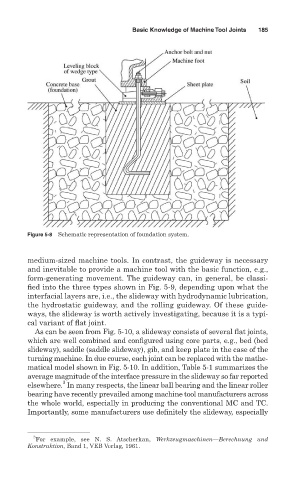
               Figure 5-8 Schematic representation of foundation system.


               medium-sized machine tools. In contrast, the guideway is necessary
               and inevitable to provide a machine tool with the basic function, e.g.,
               form-generating movement. The guideway can, in general, be classi-
               fied into the three types shown in Fig. 5-9, depending upon what the
               interfacial layers are, i.e., the slideway with hydrodynamic lubrication,
               the hydrostatic guideway, and the rolling guideway. Of these guide-
               ways, the slideway is worth actively investigating, because it is a typi-
               cal variant of flat joint.
                 As can be seen from Fig. 5-10, a slideway consists of several flat joints,
               which are well combined and configured using core parts, e.g., bed (bed
               slideway), saddle (saddle slideway), gib, and keep plate in the case of the
               turning machine. In due course, each joint can be replaced with the mathe -
               matical model shown in Fig. 5-10. In addition, Table 5-1 summarizes the
               average magnitude of the interface pressure in the slideway so far reported
                         3
               elsewhere. In many respects, the linear ball bearing and the linear roller
               bearing have recently prevailed among machine tool manufacturers across
               the whole world, especially in producing the conventional MC and TC.
               Importantly, some manufacturers use definitely the slideway, especially


                 3
                  For example, see N. S.  Atscherkan,  Werkzeugmaschinen—Berechnung und
               Konstruktion, Band 1, VEB Verlag, 1961.

