


Page 222 - Modular design for machine tools
P. 222
182   Engineering Design for Machine Tool Joints

               joint, in addition to its apparent features and structural configuration,
               the following technological aspects should be taken into consideration:
               in what way and how much the joint to be considered affects the over-
               all behavior of the machine tool. In classifying the joint, moreover, the
               joint in a  machine-tool-work system, e.g., the joint between the cutting
               tool and the work should be incorporated.
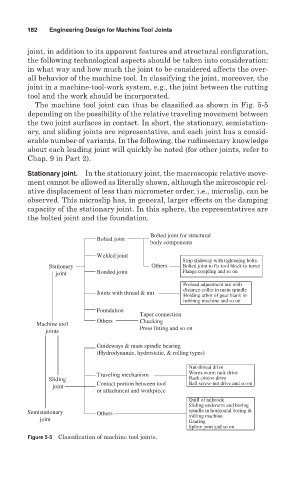
                 The machine tool joint can thus be classified as shown in Fig. 5-5
               depending on the possibility of the relative traveling movement between
               the two joint surfaces in contact. In short, the stationary, semistation-
               ary, and sliding joints are representative, and each joint has a consid-
               erable number of variants. In the following, the rudimentary knowledge
               about each leading joint will quickly be noted (for other joints, refer to
               Chap. 9 in Part 2).

               Stationary joint. In the stationary joint, the macroscopic relative move-
               ment cannot be allowed as literally shown, although the microscopic rel-
               ative displacement of less than micrometer order, i.e., microslip, can be
               observed. This microslip has, in general, larger effects on the damping
               capacity of the stationary joint. In this sphere, the representatives are
               the bolted joint and the foundation.

                                                Bolted joint for structural
                                  Bolted joint
                                                body components
                                  Welded joint
                                                         Strip slideway with tightening bolts
                     Stationary                  Others  Bolted joint to fix tool block to turret
                       joint      Bonded joint           Flange coupling and so on
                                                         Preload adjustment nut with
                                                         distance collar in main spindle
                                  Joints with thread & nut
                                                         Holding arbor of gear blank in
                                                         hobbing machine and so on
                                  Foundation
                                              Taper connection
                                  Others      Chucking
                  Machine tool
                    joints                    Press fitting and so on
                                  Guideways & main spindle bearing
                                  (Hydrodynamic, hydrostatic, & rolling types)

                                                           Nut-thread drive
                                                           Worm-worm rack drive
                                  Traveling mechanism
                     Sliding                               Rack-pinion drive
                       joint      Contact portion between tool  Ball screw-nut drive and so on
                                  or attachment and workpiece
                                                           Quill of tailstock
                                                           Sliding underarm and boring
               Semistationary     Others                   spindle in horizontal boring &
                   joint                                   milling machine
                                                           Gearing
                                                           Spline joint and so on
               Figure 5-5 Classification of machine tool joints.

