


Page 230 - Modular design for machine tools
P. 230
190   Engineering Design for Machine Tool Joints

               5.2    Definition of Machine Tool Joint and
               Representation of Joint Characteristics
               Although many studies of the joint have been carried out since 1939, it
               is difficult to exactly define what the joint is and to determine where the
               region of joint is. Intuitively, an acceptable definition is that the joint is
               a portion of roughness and/or flatness deviation of the two surfaces in
               contact, but this idea is not applicable, because of the evidence obtained
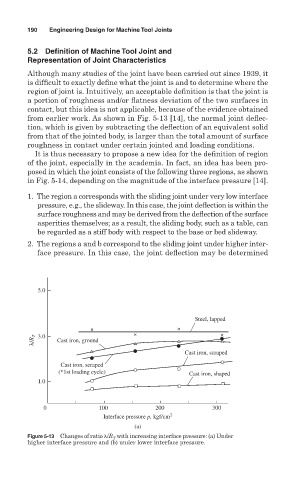
               from earlier work. As shown in Fig. 5-13 [14], the normal joint deflec-
               tion, which is given by subtracting the deflection of an equivalent solid
               from that of the jointed body, is larger than the total amount of surface
               roughness in contact under certain jointed and loading conditions.
                 It is thus necessary to propose a new idea for the definition of region
               of the joint, especially in the academia. In fact, an idea has been pro-
               posed in which the joint consists of the following three regions, as shown
               in Fig. 5-14, depending on the magnitude of the interface pressure [14].

               1. The region a corresponds with the sliding joint under very low interface
                  pressure, e.g., the slideway. In this case, the joint deflection is within the
                  surface roughness and may be derived from the deflection of the surface
                  asperities themselves; as a result, the sliding body, such as a table, can
                  be regarded as a stiff body with respect to the base or bed slideway.
               2. The regions a and b correspond to the sliding joint under higher inter-
                  face pressure. In this case, the joint deflection may be determined


                  5.0


                                                            Steel, lapped

                 λ/R T  3.0  Cast iron, ground

                                                          Cast iron, scraped
                        Cast iron, scraped
                        (*1st loading cycle)               Cast iron, shaped
                  1.0


                    0              100            200            300
                                    Interface pressure p, kgf/cm 2
                                            (a)
               Figure 5-13 Changes of ratio  /R T with increasing interface pressure: (a) Under
               higher interface pressure and (b) under lower interface pressure.

