


Page 235 - Modular design for machine tools
P. 235
Basic Knowledge of Machine Tool Joints        195


                                K , K  = P/δ,  kgf/µm
                                    sh
                                 sn
                          P
                                                    Q

                                         δ
                                                              P
                                    δ


                 Normal joint stiffness K sn  Tangential joint stiffness K sh
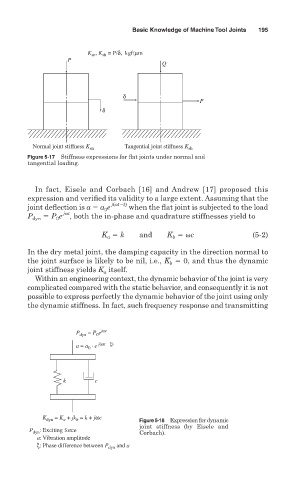
               Figure 5-17 Stiffness expressions for flat joints under normal and
               tangential loading.


                 In fact, Eisele and Corbach [16] and Andrew [17] proposed this
               expression and verified its validity to a large extent. Assuming that the
                                      j( t  )
               joint deflection is a   a e  when the flat joint is subjected to the load
                                    0
                         j t
               P dyn    P e  , both the in-phase and quadrature stiffnesses yield to
                       0
                                   K   k      and     K   c                 (5-2)
                                                      b
                                     a
               In the dry metal joint, the damping capacity in the direction normal to
               the joint surface is likely to be nil, i.e., K   0, and thus the dynamic
                                                      b
               joint stiffness yields K itself.
                                    a
                 Within an engineering context, the dynamic behavior of the joint is very
               complicated compared with the static behavior, and consequently it is not
               possible to express perfectly the dynamic behavior of the joint using only
               the dynamic stiffness. In fact, such frequency response and transmitting


                                = P e jωt
                            P dyn  0
                            a = a · e  j(ωt – ξ)
                                0


                         k        c


                   K dyn  = K  + jk  = k + jωc  Figure 5-18 Expression for dynamic
                         a
                             b
                                              joint stiffness (by Eisele and
                P dyn : Exciting force        Corbach).
                  a: Vibration amplitude
                  ξ: Phase difference between P dyn  and a

