


Page 237 - Modular design for machine tools
P. 237
Basic Knowledge of Machine Tool Joints        197

                  their own stiffness. In short, the relative stiffness of joint surround-
                  ings to the joint itself is of great importance.
                 Obviously, by taking the factors summarized above into consideration,
               we can design the simple flat joint itself, which can be regarded as a basic
               configuration of all the machine tool joints. Thus for each joint, we
               should furthermore consider other factors shown, e.g., for bolted and slid-
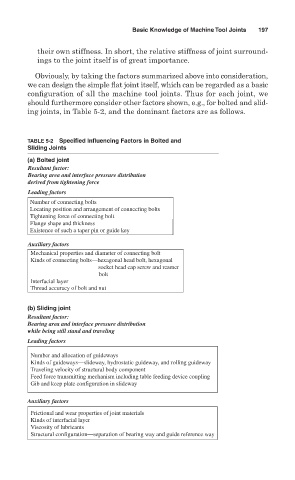
               ing joints, in Table 5-2, and the dominant factors are as follows.


               TABLE 5-2 Specified Influencing Factors in Bolted and
               Sliding Joints
               (a) Bolted joint
               Resultant factor:
               Bearing area and interface pressure distribution
               derived from tightening force
               Leading factors
                Number of connecting bolts
                Locating position and arrangement of connecting bolts
                Tightening force of connecting bolt
                Flange shape and thickness
                Existence of such a taper pin or guide key

               Auxiliary factors
                Mechanical properties and diameter of connecting bolt
                Kinds of connecting bolts—hexagonal head bolt, hexagonal
                                       socket head cap screw and reamer
                                                              bolt
                Interfacial layer
                Thread accuracy of bolt and nut


               (b) Sliding joint
               Resultant factor:
               Bearing area and interface pressure distribution
               while being still stand and traveling
               Leading factors

                Number and allocation of guideways
                Kinds of guideways—slideway, hydrostatic guideway, and rolling guideway
                Traveling velocity of structural body component
                Feed force transmitting mechanism including table feeding device coupling
                Gib and keep plate configuration in slideway

               Auxiliary factors
                Frictional and wear properties of joint materials
                Kinds of interfacial layer
                Viscosity of lubricants
                Structural configuration—separation of bearing way and guide reference way

