


Page 238 - Modular design for machine tools
P. 238
198   Engineering Design for Machine Tool Joints

               1. The  bay-type flange is very popular, e.g., in designing the bolted joint
                  for integrating both the structural body components and the con-
                  necting mechanism of the ball screw to the table. In due course, the
                  flange variations, e.g., location of the connecting bolt, configuration
                  of the bay-type with or without rib, and bay-type with enclosed bolt
                  pocket, show the larger difference in the joint stiffness.
               2. The deformation and vibration modes of the joint surroundings
                  are the leading factors in the determination of the damping
                  capacity.
               3. The structural configuration has especially large effects on the inter-
                  face pressure distribution, resulting in the differing stiffness of the
                  joint.

               5.4    Effects of Joint on Static and Dynamic
               Stiffness, and Thermal Behavior of Machine
               Tool as a Whole
               According to long-standing experiences, the static stiffness of the joint
               is, in general, very low compared with that of the structural body com-
               ponent itself. As a result, the overall stiffness of a machine tool as a
               whole deteriorates significantly, as already shown in Fig. 5-2. More
               specifically, the jointed body structure shows the following characteristic
               features under static loading.
                 First, the deterioration of the overall stiffness of a jointed structure
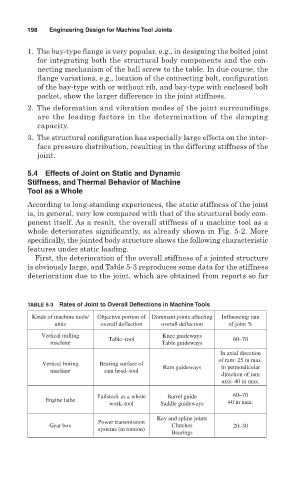
               is obviously large, and Table 5-3 reproduces some data for the stiffness
               deterioration due to the joint, which are obtained from reports so far


               TABLE 5-3 Rates of Joint to Overall Deflections in Machine Tools
                 Kinds of machine tools/  Objective portion of  Dominant joints affecting  Influencing rate
                       units       overall deflection  overall deflection  of joint %
                   Vertical milling                 Knee guideways
                      machine        Table–tool     Table guideways    60–70
                                                                   In axial direction
                                                                   of ram: 25 in max.
                   Vertical boring  Bearing surface of
                                                    Ram guideways   In perpendicular
                      machine       ram head–tool
                                                                    direction of ram
                                                                    axis: 40 in max.
                                  Tailstock as a whole  Barrel guide   60–70
                    Engine lathe                                     40 in max.
                                     work–tool     Saddle guideways
                                                  Key and spline joints
                                  Power transmission
                     Gear box                         Clutches         20–30
                                  systems (in torsion)
                                                      Bearings

