


Page 243 - Modular design for machine tools
P. 243
Basic Knowledge of Machine Tool Joints        203


                   K dyn , kgf/mm
                260                                            Stiffness of  test specimen
                                                               without joint faces
                                                               (K  = 258 kgf/mm)
                                                                 d
                                                          1
                220       2
                180
                                                        2a 0
                140                                     H         120°     20 mm
                                                          0.25 mm 20 mm
                                                                [One of  the joint surfaces,
                100
                                                                  another is ground]
                                                                ∆P = 200 kgf with 3 Hz in
                                                                         maximum in constant
                60                                             1  Without adhesive
                                                               2  Using an epoxy
                                                                resin adhesive


                 0              500           1000           1500
                                         P, kgf
                  Exciting load P dyn  = static preload P  + oscillating normal load with peak-to-peak value ∆P
                                         0
                  ∆d = corresponding peak-to-peak value of the displacement to ∆P
                  K dyn  = ∆P/∆d at preload P 0
                Figure 5-22 Dynamic stiffness of flat joint (by Dekoninck).


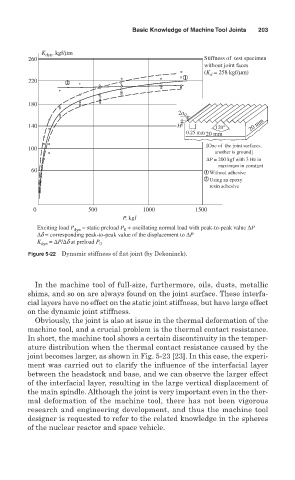
                 In the machine tool of full-size, furthermore, oils, dusts, metallic
               shims, and so on are always found on the joint surface. These interfa-
               cial layers have no effect on the static joint stiffness, but have large effect
               on the dynamic joint stiffness.
                 Obviously, the joint is also at issue in the thermal deformation of the
               machine tool, and a crucial problem is the thermal contact resistance.
               In short, the machine tool shows a certain discontinuity in the temper-
               ature distribution when the thermal contact resistance caused by the
               joint becomes larger, as shown in Fig. 5-23 [23]. In this case, the experi -
               ment was carried out to clarify the influence of the interfacial layer
               between the headstock and base, and we can observe the larger effect
               of the interfacial layer, resulting in the large vertical displacement of
               the main spindle. Although the joint is very important even in the ther-
               mal deformation of the machine tool, there has not been vigorous
               research and engineering development, and thus the machine tool
               designer is requested to refer to the related knowledge in the spheres
               of the nuclear reactor and space vehicle.

