


Page 244 - Modular design for machine tools
P. 244
204   Engineering Design for Machine Tool Joints

                  28
                 mm                                                 n = 2500 rpm
                  24
                                                                      Fullsize
                                                                      Model
                  20
                                                                    n = 2000 rpm
                  16
                                                                      n = 1000 rpm
                 ∆Z/λ l  12
                 ∆Z,                                                   Z
                   8                      Z
                                                 H
                   4
                                         Fundament
                   0    0.1  0.2  0.3  0.4  0.5  0.6  0.7  0.8  0.9  1.0  1.1
                                                    a ·t
                                                      l
                                      Fourier number F  =
                                                 0
                                                     H 2
                      Length scale factor λ  = 0.667
                                    l
                       t: Time
                      a : Thermal conductance
                       λ
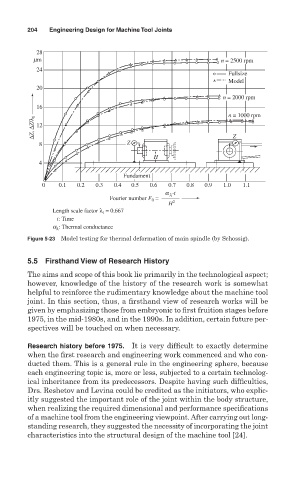
               Figure 5-23 Model testing for thermal deformation of main spindle (by Schossig).
               5.5    Firsthand View of Research History
               The aims and scope of this book lie primarily in the technological aspect;
               however, knowledge of the history of the research work is somewhat
               helpful to reinforce the rudimentary knowledge about the machine tool
               joint. In this section, thus, a firsthand view of research works will be
               given by emphasizing those from embryonic to first fruition stages before
               1975, in the mid-1980s, and in the 1990s. In addition, certain future per-
               spectives will be touched on when necessary.

               Research history before 1975. It is very difficult to exactly determine
               when the first research and engineering work commenced and who con-
               ducted them. This is a general rule in the engineering sphere, because
               each engineering topic is, more or less, subjected to a certain technolog-
               ical inheritance from its predecessors. Despite having such difficulties,
               Drs. Reshetov and Levina could be credited as the initiators, who explic-
               itly suggested the important role of the joint within the body structure,
               when realizing the required dimensional and performance specifications
               of a machine tool from the engineering viewpoint. After carrying out  long-
               standing research, they suggested the necessity of incorporating the joint
               characteristics into the structural design of the machine tool [24].

