


Page 247 - Modular design for machine tools
P. 247
Basic Knowledge of Machine Tool Joints        207

               especially those in civil engineering, believe in the wider availability of
               Rötscher’s pressure cone even in the 2000s.
               Research trends between 1975 and 1985.  The static, dynamic, and ther-
               mal behavior of the joint has been clarified to a larger and various
               extent by the research works carried out up to 1975. In due course, the
               designer is capable of conducting the design of the body structure, if nec-
               essary, in consideration of the joint characteristics. In addition, it is
               possible to estimate the behavior of other joints that have not yet been
               investigated by bringing together the knowledge about the representa-
               tive joints so far investigated in detail.
                 In this second phase, researchers and engineers extended their focus to
               the joints in the accessories and peripheral equipment, whereas the
               research subject of the sliding joint was duly ramified in accordance with
               the performance enhancement of the machine tool. In fact, at burning
               issue was the taper connection between the main spindle and the tool
               shank, as well as the connecting mechanism between the table and its driv-
               ing system. To continue with the former subject, the focus is, as will be
               stated later, the HSK (hollow shank tool) for MC and TC, and it becomes
               a pronounced area of interest in the 1990s. In contrast, the latter is one
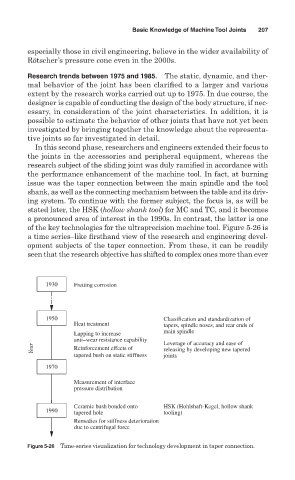
               of the key technologies for the ultraprecision machine tool. Figure 5-26 is
               a time series–like firsthand view of the research and engineering devel-
               opment subjects of the taper connection. From these, it can be readily
               seen that the research objective has shifted to complex ones more than ever


                    1930    Fretting corrosion


                    1950                            Classification and standardization of
                            Heat treatment          tapers, spindle noses, and rear ends of
                                                    main spindle
                            Lapping to increase
                            anti–wear resistance capability  Leverage of accuracy and ease of
                 Year       Reinforcement effects of   releasing by developing new tapered
                            tapered bush on static stiffness  joints
                    1970

                            Measurement of interface
                            pressure distribution

                            Ceramic bush bonded onto  HSK (Hohlshaft-Kegel, hollow shank
                    1990    tapered hole            tooling)
                            Remedies for stiffness deterioration
                            due to centrifugal force

               Figure 5-26 Time-series visualization for technology development in taper connection.

