


Page 228 - Modular design for machine tools
P. 228
188   Engineering Design for Machine Tool Joints

               of the hydrostatic guideway in step loading was investigated in consid-
               eration of the fluid capacitance in the oil feed line. Obviously, the fluid
               capacitance is derived from the compressibility of the pressurized oil,
               elastic deformation of the pipe, and intermixing of air across the whole
               system. In short, the ratio of the overshoot to the steady displacement of
               the table increases with increasing fluid capacitance in piping and has a
               maximum value when the oil film stiffness is a maximum. Within an
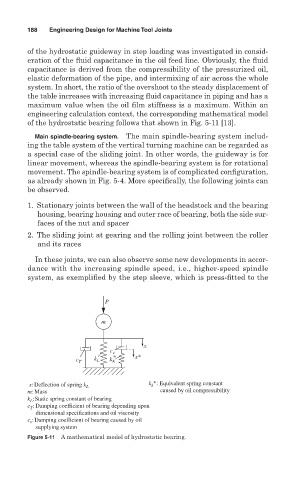
               engineering calculation context, the corresponding mathematical model
               of the hydrostatic bearing follows that shown in Fig. 5-11 [13].
                 Main spindle-bearing system. The main  spindle-bearing system includ-
               ing the table system of the vertical turning machine can be regarded as
               a special case of the sliding joint. In other words, the guideway is for
               linear movement, whereas the spindle-bearing system is for rotational
               movement. The spindle-bearing system is of complicated configuration,
               as already shown in Fig. 5-4. More specifically, the following joints can
               be observed.
               1. Stationary joints between the wall of the headstock and the bearing
                  housing, bearing housing and outer race of bearing, both the side sur-
                  faces of the nut and spacer
               2. The sliding joint at gearing and the rolling joint between the roller
                  and its races
                 In these joints, we can also observe some new developments in accor-
               dance with the increasing spindle speed, i.e.,  higher- speed spindle
               system, as exemplified by the step sleeve, which is  press-fitted to the


                                    P


                                   m


                                               x
                                      c v
                            c T  k L  k K *  x*


                                                k *: Equivalent spring constant
                x: Deflection of spring k L      k
               m: Mass                                  caused by oil compressibility
               k :Static spring constant of bearing
                L
               c : Damping coefficient of bearing depending upon
                T
                    dimensional specifications and oil viscosity
               c :Damping coefficient of bearing caused by oil
                v
                    supplying system
               Figure 5-11 A mathematical model of hydrostatic bearing.

