


Page 229 - Modular design for machine tools
P. 229
Basic Knowledge of Machine Tool Joints        189

               main spindle and can thus render the bearing nut useless to minimize
               the unbalance. In short, the  spindle-bearing system is one of the com-
               plex joints, as is the foundation.

               Semistationary joint. This joint can be regarded as a variant of the sta-
               tionary or sliding joint, and a typical example is a slideway with a
               clamping mechanism. The slideway behaves like the stationary joint or
               sliding joint depending on whether the clamping mechanism is in work-
               ing condition or not.
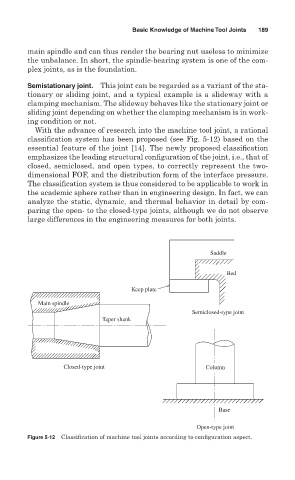
                 With the advance of research into the machine tool joint, a rational
               classification system has been proposed (see Fig. 5-12) based on the
               essential feature of the joint [14]. The newly proposed classification
               emphasizes the leading structural configuration of the joint, i.e., that of
               closed, semiclosed, and open types, to correctly represent the  two-
               dimensional FOF, and the distribution form of the interface pressure.
               The classification system is thus considered to be applicable to work in
               the academic sphere rather than in engineering design. In fact, we can
               analyze the static, dynamic, and thermal behavior in detail by com-
               paring the open- to the  closed-type joints, although we do not observe
               large differences in the engineering measures for both joints.


                                                                 Saddle


                                                                     Bed
                                           Keep plate

                  Main spindle
                                                            Semiclosed-type joint
                                    Taper shank


                         Closed-type joint                     Column


                                                                   Base

                                                             Open-type joint
               Figure 5-12 Classification of machine tool joints according to configuration aspect.

