


Page 210 - Multidimensional Chromatography
P. 210
Multidimensional Electrodriven Separations                      203


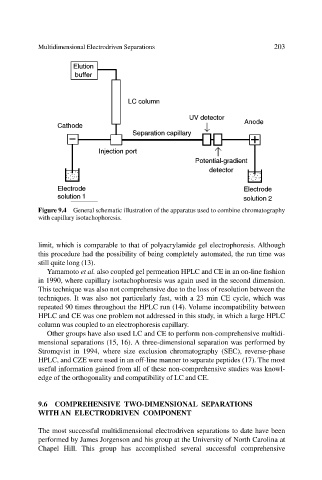
                           Figure 9.4 General schematic illustration of the apparatus used to combine chromatography
                           with capillary isotachophoresis.


                           limit, which is comparable to that of polyacrylamide gel electrophoresis. Although
                           this procedure had the possibility of being completely automated, the run time was
                           still quite long (13).
                              Yamamoto et al. also coupled gel permeation HPLC and CE in an on-line fashion
                           in 1990, where capillary isotachophoresis was again used in the second dimension.
                           This technique was also not comprehensive due to the loss of resolution between the
                           techniques. It was also not particularly fast, with a 23 min CE cycle, which was
                           repeated 90 times throughout the HPLC run (14). Volume incompatibility between
                           HPLC and CE was one problem not addressed in this study, in which a large HPLC
                           column was coupled to an electrophoresis capillary.
                              Other groups have also used LC and CE to perform non-comprehensive multidi-
                           mensional separations (15, 16). A three-dimensional separation was performed by
                           Stromqvist in 1994, where size exclusion chromatography (SEC), reverse-phase
                           HPLC, and CZE were used in an off-line manner to separate peptides (17). The most
                           useful information gained from all of these non-comprehensive studies was knowl-
                           edge of the orthogonality and compatibility of LC and CE.


                           9.6  COMPREHENSIVE TWO-DIMENSIONAL SEPARATIONS
                           WITH AN ELECTRODRIVEN COMPONENT

                           The most successful multidimensional electrodriven separations to date have been
                           performed by James Jorgenson and his group at the University of North Carolina at
                           Chapel Hill.  This group has accomplished several successful comprehensive

