


Page 399 - Book Hosokawa Nanoparticle Technology Handbook
P. 399
6.7 OPTICAL PROPERTIES                                                       FUNDAMENTALS
                  (photoluminescence). Scattering takes place based on    I       46  2  1⎞
                                                                                 d ⎛
                  the inhomogeneity of a substance.                              24 ⎜  m    ⎟  ( 1  cos 2   )  (6.7.1)
                                                                                      2
                    The pattern of scattering depends on the light wave-  I  0  8 R   ⎝  m   1⎠
                  length and the particle size to be measured. A large  where I is the intensity of the incident light, R the dis-
                                                                      0
                  particle, with micrometer to millimeter order diameter,  tance, m the refractive index,   the wavelength of inci-
                  scatters light forward at a comparatively narrow angle.  dent light, and d the particle diameter. This equation
                  Mie scattering prevails in particulates with a particle  indicates that light with a shorter wavelength is scat-
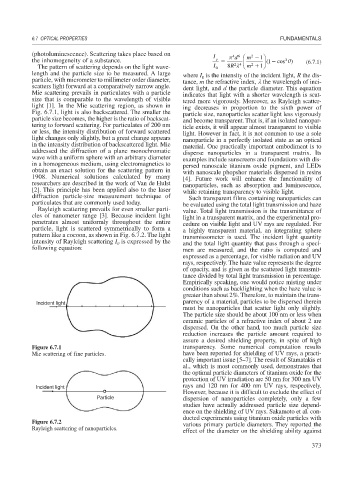
                  size that is comparable to the wavelength of visible  tered more vigorously. Moreover, as Rayleigh scatter-
                  light [1]. In the Mie scattering region, as shown in  ing decreases in proportion to the sixth power of
                  Fig. 6.7.1, light is also backscattered. The smaller the  particle size, nanoparticles scatter light less vigorously
                  particle size becomes, the higher is the ratio of backscat-  and become transparent. That is, if an isolated nanopar-
                  tering to forward scattering. For particulates of 200 nm  ticle exists, it will appear almost transparent to visible
                  or less, the intensity distribution of forward scattered  light. However in fact, it is not common to use a sole
                  light changes only slightly, but a great change appears  nanoparticle in a perfectly isolated state as an optical
                  in the intensity distribution of backscattered light. Mie  material. One practically important embodiment is to
                  addressed the diffraction of a plane monochromatic  disperse nanoparticles in a transparent matrix. Its
                  wave with a uniform sphere with an arbitrary diameter  examples include sunscreens and foundations with dis-
                  in a homogeneous medium, using electromagnetics to  persed nanoscale titanium oxide pigment, and LEDs
                  obtain an exact solution for the scattering pattern in  with nanoscale phopshor materials dispersed in resins
                  1908. Numerical solutions calculated by many   [4]. Future work will enhance the functionality of
                  researchers are described in the work of Van de Hulst  nanoparticles, such as absorption and luminescence,
                  [2]. This principle has been applied also to the laser  while retaining transparency to visible light.
                  diffraction particle-size measurement technique of  Such transparent films containing nanoparticles can
                  particulates that are commonly used today.     be evaluated using the total light transmission and haze
                    Rayleigh scattering prevails for even smaller parti-  value. Total light transmission is the transmittance of
                  cles of nanometer range [3]. Because incident light  light in a transparent matrix, and the experimental pro-
                  penetrates almost uniformly throughout the entire  cedure on visible light and UV rays are regulated. For
                  particle, light is scattered symmetrically to form a  a highly transparent material, an integrating sphere
                  pattern like a cocoon, as shown in Fig. 6.7.2. The light  transmissometer is used.  The incident light quantity
                  intensity of Rayleigh scattering I is expressed by the  and the total light quantity that pass through a speci-

                  following equation:
                                                                 men are measured, and the ratio is computed and
                                                                 expressed as a percentage, for visible radiation and UV
                                                                 rays, respectively. The haze value represents the degree
                                                                 of opacity, and is given as the scattered light transmit-
                                                                 tance divided by total light transmission in percentage.
                                                                 Empirically speaking, one would notice misting under
                                                                 conditions such as backlighting when the haze value is
                                                                 greater than about 2%. Therefore, to maintain the trans-
                   Incident light                                parency of a material, particles to be dispersed therein
                                                                 must be nanoparticles that scatter light only slightly.
                                                                 The particle size should be about 100 nm or less when
                                                                 ceramic particles of a refractive index of about 2 are
                                                                 dispersed. On the other hand, too much particle size
                                                                 reduction increases the particle amount required to
                                                                 assure a desired shielding property, in spite of high
                  Figure 6.7.1                                   transparency. Some numerical computation results
                  Mie scattering of fine particles.              have been reported for shielding of UV rays, a practi-
                                                                 cally important issue [5–7]. The result of Stamatakis et
                                                                 al., which is most commonly used, demonstrates that
                                                                 the optimal particle diameters of titanium oxide for the
                                                                 protection of UV irradiation are 50 nm for 300 nm UV
                   Incident light                                rays and 120 nm for 400 nm UV rays, respectively.
                                                                 However, because it is difficult to exclude the effect of
                                      Particle                   dispersion of nanoparticles completely, only a few
                                                                 studies have actually addressed particle size depend-
                                                                 ence on the shielding of UV rays. Sakamoto et al. con-
                                                                 ducted experiments using titanium oxide particles with
                  Figure 6.7.2                                   various primary particle diameters. They reported the
                  Rayleigh scattering of nanoparticles.
                                                                 effect of the diameter on the shielding ability against
                                                                                                        373

