


Page 601 - Book Hosokawa Nanoparticle Technology Handbook
P. 601
36 DEVELOPMENT OF A HIGH-PERFORMANCE SECONDARY BATTERY                        APPLICATIONS

                           Cobalt coating
                                                                                         CoOOH
                                                         Co(OH) 2
                                                  Ni(OH) 2
                     Ni(OH) 2    Co(OH) 2

                      Adding cobalt compound   KOHaq.                     Charge
                                                                         (oxidation)
                                                                −
                                                          Co(OH) 4               Electron conduction path network


                     Ni(OH) 2
                                CoO/Co(OH) 2

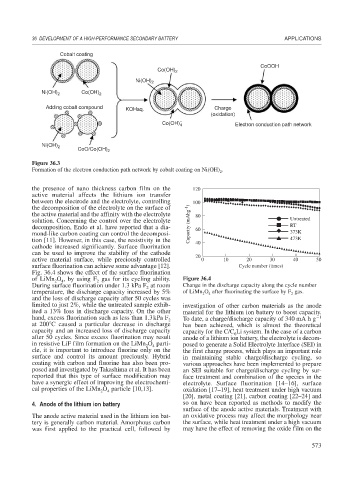
                  Figure 36.3
                  Formation of the electron conduction path network by cobalt coating on Ni(OH) .
                                                                            2
                  the presence of nano thickness carbon film on the  120
                  active material affects the lithium ion transfer
                  between the electrode and the electrolyte, controlling  100
                  the decomposition of the electrolyte on the surface of
                  the active material and the affinity with the electrolyte  80
                  solution. Concerning the control over the electrolyte                           Untreated
                  decomposition, Endo et al. have reported that a dia-  Capacity (mAhg -1 )  60   RT
                  mond-like carbon coating can control the decomposi-                             373K
                  tion [11]. However, in this case, the resistivity in the  40                    473K
                  cathode increased significantly. Surface fluorination
                  can be used to improve the stability of the cathode  20
                  active material surface, while preciously controlled  0    10     20     30      40     50
                  surface fluorination can achieve some advantage [12].           Cycle number (times)
                  Fig. 36.4 shows the effect of the surface fluorination
                  of LiMn O , by using F gas for its cycling ability.  Figure 36.4
                         2  4         2
                  During surface fluorination under 1.3 kPa F at room  Change in the discharge capacity along the cycle number
                                                     2
                  temperature, the discharge capacity increased by 5%  of LiMn O after fluorinating the surface by F gas.
                                                                         4
                                                                       2
                                                                                                  2
                  and the loss of discharge capacity after 50 cycles was
                  limited to just 2%, while the untreated sample exhib-  investigation of other carbon materials as the anode
                  ited a 13% loss in discharge capacity. On the other  material for the lithium ion battery to boost capacity.
                  hand, excess fluorination such as less than 1.3kPa F                                     1
                                                            2    To date, a charge/discharge capacity of 340 mA h g
                  at 200 C caused a particular decrease in discharge  has been achieved, which is almost the theoretical
                  capacity and an increased loss of discharge capacity  capacity for the C/C Li system. In the case of a carbon
                                                                                6
                  after 50 cycles. Since excess fluorination may result  anode of a lithium ion battery, the electrolyte is decom-
                  in resistive LiF film formation on the LiMn O parti-
                                                     2  4        posed to generate a Solid Electrolyte Interface (SEI) in
                  cle, it is important to introduce fluorine only on the  the first charge process, which plays an important role
                  surface and control its amount preciously. Hybrid  in maintaining stable charge/discharge cycling, so
                  coating with carbon and fluorine has also been pro-  various approaches have been implemented to prepare
                  posed and investigated by Takashima et al. It has been  an SEI suitable for charge/discharge cycling by sur-
                  reported that this type of surface modification may  face treatment and combination of the species in the
                  have a synergic effect of improving the electrochemi-  electrolyte. Surface fluorination [14–16], surface
                  cal properties of the LiMn O particle [10,13].
                                       2  4                      oxidation [17–19], heat treatment under high vacuum
                                                                 [20], metal coating [21], carbon coating [22–24] and
                  4. Anode of the lithium ion battery            so on have been reported as methods to modify the
                                                                 surface of the anode active materials. Treatment with
                  The anode active material used in the lithium ion bat-  an oxidative process may affect the morphology near
                  tery is generally carbon material. Amorphous carbon  the surface, while heat treatment under a high vacuum
                  was first applied to the practical cell, followed by  may have the effect of removing the oxide film on the
                                                                                                        573

