


Page 598 - Book Hosokawa Nanoparticle Technology Handbook
P. 598
APPLICATIONS                                36 DEVELOPMENT OF A HIGH-PERFORMANCE SECONDARY BATTERY

                           50
                                     Gmax16kV/cm
                                     Gmax14kV/cm
                           45        Gmax12kV/cm                               1  Audible noise level (dB(A))
                                                                               2   Super-hydrophilic
                           40
                                                                               3   Hydrophilic
                           35                                                  4   Hydrophobic
                         1
                                                                               5   Super-hydrophobic
                           30
                                                                                6   Contact angle   (degree)
                                    2
                           25
                                          3                  4         5

                           20  0     30      60     90      120     150    180
                                                    6

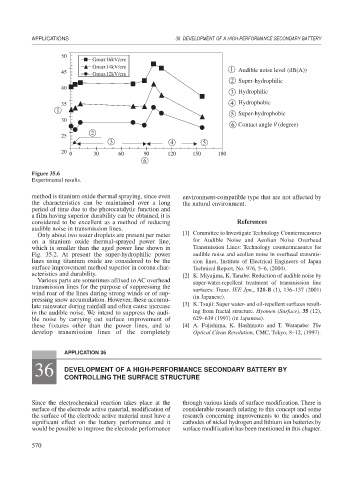
                  Figure 35.6
                  Experimental results.

                  method is titanium oxide thermal spraying, since even  environment-compatible type that are not affected by
                  the characteristics can be maintained over a long  the natural environment.
                  period of time due to the photocatalytic function and
                  a film having superior durability can be obtained, it is
                  considered to be excellent as a method of reducing             References
                  audible noise in transmission lines.
                    Only about two water droplets are present per meter  [1] Committee to Investigate Technology Countermeasures
                  on a titanium oxide thermal-sprayed power line,   for  Audible Noise and  Aeolian Noise Overhead
                  which is smaller than the aged power line shown in  Transmission Lines: Technology countermeasures for
                  Fig. 35.2.  At present the super-hydrophilic power  audible noise and aeolian noise in overhead transmis-
                  lines using titanium oxide are considered to be the  sion lines, Institute of Electrical Engineers of Japan
                  surface improvement method superior in corona char-  Technical Report, No. 976, 5–6, (2004).
                  acteristics and durability.                    [2] K. Miyajima, K. Tanabe: Reduction of audible noise by
                    Various parts are sometimes affixed to AC overhead  super-water-repellent treatment of transmission line
                  transmission lines for the purpose of suppressing the  surfaces: Trans. IEE Jpn., 121-B (1), 136–137 (2001)
                  wind roar of the lines during strong winds or of sup-  (in Japanese).
                  pressing snow accumulation. However, these accumu-
                  late rainwater during rainfall and often cause increase  [3] K. Tsujii: Super water- and oil-repellent surfaces result-
                  in the audible noise. We intend to suppress the audi-  ing from fractal structure. Hyomen (Surface), 35 (12),
                  ble noise by carrying out surface improvement of  629–639 (1997) (in Japanese).
                  these fixtures other than the power lines, and to  [4] A. Fujishima, K. Hashimoto and  T.  Watanabe:  The
                  develop transmission lines of the completely      Optical Clean Revolution, CMC, Tokyo, 8–12, (1997).


                            APPLICATION 36

                   36       DEVELOPMENT OF A HIGH-PERFORMANCE SECONDARY BATTERY BY
                            CONTROLLING THE SURFACE STRUCTURE


                  Since the electrochemical reaction takes place at the  through various kinds of surface modification. There is
                  surface of the electrode active material, modification of  considerable research relating to this concept and some
                  the surface of the electrode active material must have a  research concerning improvements to the anodes and
                  significant effect on the battery performance and it  cathodes of nickel hydrogen and lithium ion batteries by
                  would be possible to improve the electrode performance  surface modification has been mentioned in this chapter.

                  570

