


Page 595 - Book Hosokawa Nanoparticle Technology Handbook
P. 595
35 AC OVERHEAD TRANSMISSION LINE AUDIBLE-NOISE REDUCTION                      APPLICATIONS


                                                Hydrophobicity   Hydrophilicity
                                                  L
                                  Smooth surface    S      SL


                                                              r t  imes    Tr ue surface area
                                                                           Apparent surface        area
                                   Rough surface
                                                      f
                                                                  f


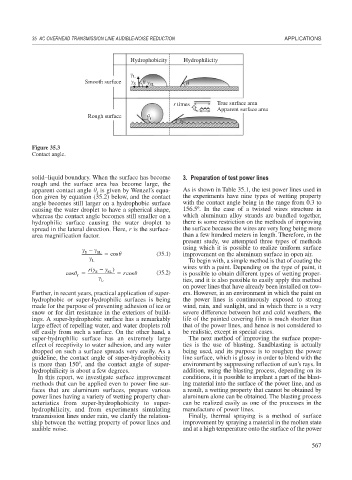
                  Figure 35.3
                  Contact angle.


                  solid–liquid boundary. When the surface has become  3. Preparation of test power lines
                  rough and the surface area has become large, the
                  apparent contact angle   is given by Wenzel’s equa-  As is shown in Table 35.1, the test power lines used in
                                      f
                  tion given by equation (35.2) below, and the contact  the experiments have nine types of wetting property
                  angle becomes still larger on a hydrophobic surface  with the contact angle being in the range from 0.3 to
                  causing the water droplet to have a spherical shape,  156.5º. In the case of a twisted wires structure in
                  whereas the contact angle becomes still smaller on a  which aluminum alloy strands are bundled together,
                  hydrophilic surface causing the water droplet to  there is some restriction on the methods of improving
                  spread in the lateral direction. Here, r is the surface-  the surface because the wires are very long being more
                  area magnification factor.                     than a few hundred meters in length. Therefore, in the
                                                                 present study, we attempted three types of methods
                                        SL    cos       (35.1)   using which it is possible to realize uniform surface
                                  S
                                      L                          improvement on the aluminum surface in open air.
                                                                  To begin with, a simple method is that of coating the
                                   r (       )                   wires with a paint. Depending on the type of paint, it
                            cos       S  SL    r cos    (35.2)   is possible to obtain different types of wetting proper-
                                         L                       ties, and it is also possible to easily apply this method
                                f
                                                                 on power lines that have already been installed on tow-
                  Further, in recent years, practical application of super-  ers. However, in an environment in which the paint on
                  hydrophobic or super-hydrophilic surfaces is being  the power lines is continuously exposed to strong
                  made for the purpose of preventing adhesion of ice or  wind, rain, and sunlight, and in which there is a very
                  snow or for dirt resistance in the exteriors of build-  severe difference between hot and cold weathers, the
                  ings. A super-hydrophobic surface has a remarkably  life of the painted covering film is much shorter than
                  large effect of repelling water, and water droplets roll  that of the power lines, and hence is not considered to
                  off easily from such a surface. On the other hand, a  be realistic, except in special cases.
                  super-hydrophilic surface has an extremely large  The next method of improving the surface proper-
                  effect of receptivity to water adhesion, and any water  ties is the use of blasting. Sandblasting is actually
                  dropped on such a surface spreads very easily. As a  being used, and its purpose is to roughen the power
                  guideline, the contact angle of super-hydrophobicity  line surface, which is glossy in order to blend with the
                  is more than 150 , and the contact angle of super-  environment by suppressing reflection of sun’s rays. In
                  hydrophilicity is about a few degrees.         addition, using the blasting process, depending on its
                    In this report, we investigate surface improvement  conditions, it is possible to implant a part of the blast-
                  methods that can be applied even to power line sur-  ing material into the surface of the power line, and as
                  faces that are aluminum surfaces, prepare various  a result, a wetting property that cannot be obtained by
                  power lines having a variety of wetting property char-  aluminum alone can be obtained. The blasting process
                  acteristics from super-hydrophobicity to super-  can be realized easily as one of the processes in the
                  hydrophilicity, and from experiments simulating  manufacture of power lines.
                  transmission lines under rain, we clarify the relation-  Finally, thermal spraying is a method of surface
                  ship between the wetting property of power lines and  improvement by spraying a material in the molten state
                  audible noise.                                 and at a high temperature onto the surface of the power

                                                                                                        567

