


Page 592 - Book Hosokawa Nanoparticle Technology Handbook
P. 592
APPLICATIONS                                                   34 DEVELOPMENT OF PHOTOCATALYST

                     25                                            200
                                                                   180               → UV irradiation

                                                                   160
                     20                                            140
                   Formaldehyde Conc. (ppm)  15                   Gas Conc. (ppm)  80 0  HCHO     CO 2
                                                                   120
                                                                   100
                                                                    60
                                                                    40
                                                                    20
                     10


                      5                                            −20  0         5  Time (h)  10        15
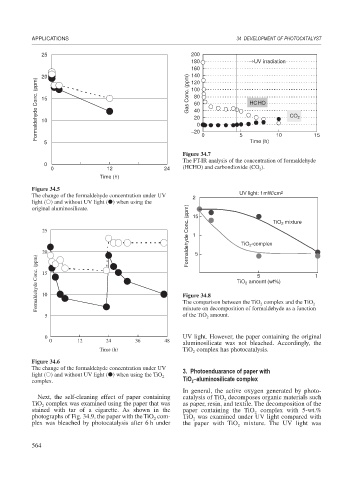
                                                                 Figure 34.7
                                                                 The FT-IR analysis of the concentration of formaldehyde
                      0
                        0                12                24    (HCHO) and carbondioxide (CO ).
                                                                                        2
                                       Time (h)
                  Figure 34.5
                  The change of the formaldehyde concentration under UV  20       UV light: 1 mW/cm 2
                  light ( ) and without UV light ( ) when using the
                                                                  Formaldehyde Conc. (ppm)   10
                  original aluminosilicate.                         15


                     25                                                                     TiO 2  mixture


                     20                                             5              TiO 2 -complex
                   Formaldehyde Conc. (ppm)  15                  Figure 34.8     TiO 2  amount (wt%)     10

                                                                    0
                                                                     0
                                                                                        5
                     10
                                                                                         2
                                                                 mixture on decomposition of formaldehyde as a function
                                                                 of the TiO amount.
                      5                                          The comparison between the TiO complex and the TiO 2
                                                                        2
                      0                                          UV light. However, the paper containing the original
                       0        12       24       36       48
                                                                 aluminosilicate was not bleached.  Accordingly, the
                                       Time (h)                  TiO complex has photocatalysis.
                                                                    2
                  Figure 34.6
                  The change of the formaldehyde concentration under UV  3. Photoenduarance of paper with
                  light ( ) and without UV light ( ) when using the TiO
                                                          2
                  complex.                                       TiO –aluminosilicate complex
                                                                   2
                                                                 In general, the active oxygen generated by photo-
                    Next, the self-cleaning effect of paper containing  catalysis of TiO decomposes organic materials such
                                                                             2
                  TiO complex was examined using the paper that was  as paper, resin, and textile. The decomposition of the
                     2
                  stained with tar of a cigarette.  As shown in the  paper containing the  TiO complex with 5-wt.%
                                                                                       2
                  photographs of Fig. 34.9, the paper with the TiO com-  TiO was examined under UV light compared with
                                                        2
                                                                    2
                  plex was bleached by photocatalysis after 6 h under  the paper with  TiO mixture.  The UV light was
                                                                                  2
                  564

