


Page 588 - Book Hosokawa Nanoparticle Technology Handbook
P. 588
APPLICATIONS                                      33 DEVELOPMENT OF BRIGHT PHOSPHORS USING GLASSES
                  (1) Preparation of bulk glass phosphors        micelles. Bawendi et al. prepared photoluminescent
                  Sol–gel derived bulk glass phosphors incorporating  small glass beads by forming thin silica layer contain-
                  semiconductor nanoparticles can be prepared by  ing semiconductor nanoparticles by a sol–gel method
                  hydrolysis of alkoxysilane or alkoxide in solutions  onto the surface of a silica bead without containing
                  mixed with aqueous solutions of semiconductor  nanoparticles [19]. Alivisatos et al. reported a com-
                  nanoparticles [6,15,16].  When using alkoxysilane  plex chemical synthetic method to deposit mono- and
                  such as 3-aminopropyltrimethoxysilane (APS) having  multilayers of silica onto the surface of a single semi-
                  an amino group that adsorbs TGA on the surface of  conductor nanoparticle [20]. Compared with those
                  nanoparticles, the agglomeration of the nanoparticles  methods, inverse micelle-based methods have advan-
                  was suppressed and led to bright glass phosphors. It  tages such as good controllability of glass bead size
                  was possible to incorporate CdTe nanoparticles up to  and nanoparticle concentration in a glass bead. The
                  the concentration of ca. 2   10  4  mol/l in the bulk  following two preparation methods have been devel-
                  glass. The obtained bulk glass phosphors showed PL  oped by the authors using inverse micelles.
                  spectra similar to those of the aqueous solutions of  In the first preparation method, an inverse micelle
                  nanoparticles, and exhibited PL efficiencies higher  of an ionic surfactant  Aerosol OT (AOT) (sodium
                  than 40%. These glass phosphors retained PL effi-  bis(2-ethylhexyl) sulfosuccinate) is formed in a
                  ciencies of higher than 30% even after 6 months of  hydrophobic organic solvent isooctane. Then aque-
                  preparation, demonstrating superior long-term stabil-  ous solution of CdTe nanoparticles is mixed to
                  ity [6,16]. In a similar manner, blue-emitting bulk  generate inverse micelles that involve small droplets
                  glass phosphors incorporating ZnSe nanoparticles can  of the nanoparticle solution. Afterwards, an alkoxide
                  be prepared. It is also possible to fabricate bulk glass  tetraethoxysilane (TEOS) is added, and the solution is
                  phosphors having various shapes and PL colors under  stirred for 1–3 days in order to complete the hydroly-
                  atmospheric pressure and at room temperature, by  sis of TEOS. As a result, small glass bead phosphors
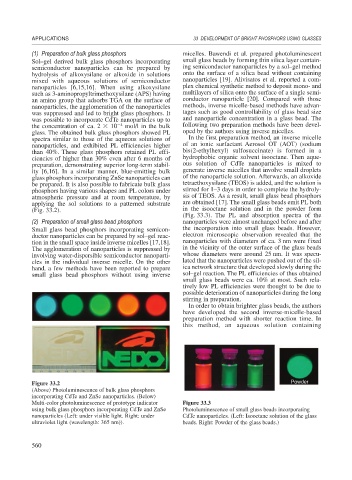
                  applying the sol solutions to a patterned substrate  are obtained [17]. The small glass beads emit PL both
                  (Fig. 33.2).                                   in the isooctane solution and in the powder form
                                                                 (Fig. 33.3).  The PL and absorption spectra of the
                  (2) Preparation of small glass bead phosphors  nanoparticles were almost unchanged before and after
                  Small glass bead phosphors incorporating semicon-  the incorporation into small glass beads. However,
                  ductor nanoparticles can be prepared by sol–gel reac-  electron microscopic observation revealed that the
                  tion in the small space inside inverse micelles [17,18].  nanoparticles with diameters of ca. 3 nm were fixed
                  The agglomeration of nanoparticles is suppressed by  in the vicinity of the outer surface of the glass beads
                  involving water-dispersible semiconductor nanoparti-  whose diameters were around 25 nm. It was specu-
                  cles in the individual inverse micelle. On the other  lated that the nanoparticles were pushed out of the sil-
                  hand, a few methods have been reported to prepare  ica network structure that developed slowly during the
                  small glass bead phosphors without using inverse  sol–gel reaction. The PL efficiencies of thus obtained
                                                                 small glass beads were ca. 10% at most. Such rela-
                                                                 tively low PL efficiencies were thought to be due to
                                                                 possible deterioration of nanoparticles during the long
                                                                 stirring in preparation.
                                                                  In order to obtain brighter glass beads, the authors
                                                                 have developed the second inverse-micelle-based
                                                                 preparation method with shorter reaction time. In
                                                                 this method, an aqueous solution containing


                  Figure 33.2                                                                     Powder
                  (Above) Photoluminescence of bulk glass phosphors
                  incorporating CdTe and ZnSe nanoparticles. (Below)
                  Multi-color photoluminescence of prototype indicator  Figure 33.3
                  using bulk glass phosphors incorporating CdTe and ZnSe  Photoluminescence of small glass beads incorporating
                  nanoparticles (Left: under visible light. Right: under  CdTe nanoparticles. (Left: Isooctane solution of the glass
                  ultraviolet light (wavelength: 365 nm)).       beads. Right: Powder of the glass beads.)


                  560

