


Page 587 - Book Hosokawa Nanoparticle Technology Handbook
P. 587
33 DEVELOPMENT OF BRIGHT PHOSPHORS USING GLASSES                              APPLICATIONS
                    In the following are introduced the syntheses of
                  highly photoluminescent CdTe and ZnSe nanoparti-
                  cles and the preparation of glass phosphors incor-
                  porating those nanoparticles with three different  Vis light
                  forms.


                  1. Syntheses of highly photoluminescent
                  semiconductor nanoparticles by an aqueous solution  UV light
                  method
                  There is a general rule that the bandgap (Eg) of group
                  II–VI semiconductors becomes narrower as the con-
                  stituent atoms become heavier. In the case of            3 nm                      4 nm
                  nanoparticles with diameters of ca. 2–10 nm, the Eg
                  is increased due to the quantum size effect compared  Figure 33.1
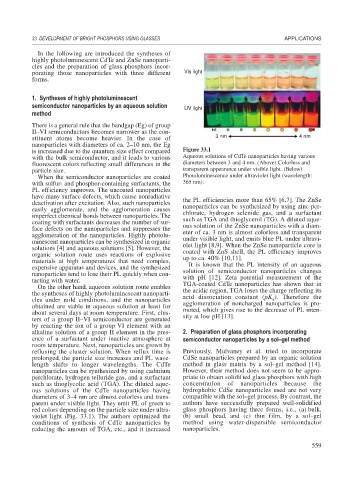
                  with the bulk semiconductor, and it leads to various  Aqueous solutions of CdTe nanoparticles having various
                  fluorescent colors reflecting small differences in the  diameters between 3 and 4 nm. (Above) Colorless and
                  particle size.                                 transparent appearance under visible light. (Below)
                    When the semiconductor nanoparticles are coated  Photoluminescence under ultraviolet light (wavelength:
                  with sulfur- and phosphor-containing surfactants, the  365 nm).
                  PL efficiency improves. The uncoated nanoparticles
                  have many surface defects, which cause nonradiative  the PL efficiencies more than 65% [6,7]. The ZnSe
                  deactivation after excitation. Also, such nanoparticles  nanoparticles can be synthesized by using zinc per-
                  easily agglomerate, and the agglomeration causes  chlorate, hydrogen selenide gas, and a surfactant
                  imperfect chemical bonds between nanoparticles. The  such as TGA and thioglycerol (TG). A diluted aque-
                  coating with surfactants decreases the number of sur-  ous solution of the ZnSe nanoparticles with a diam-
                  face defects on the nanoparticles and suppresses the  eter of ca. 3 nm is almost colorless and transparent
                  agglomeration of the nanoparticles. Highly photolu-  under visible light, and emits blue PL under ultravi-
                  minescent nanoparticles can be synthesized in organic  olet light [8,9]. When the ZnSe nanoparticle core is
                  solutions [4] and aqueous solutions [5]. However, the  coated with ZnS shell, the PL efficiency improves
                  organic solution route uses reactions of explosive  up to ca. 40% [10,11].
                  materials at high temperatures that need complex,  It is known that the PL intensity of an aqueous
                  expensive apparatus and devices, and the synthesized  solution of semiconductor nanoparticles changes
                  nanoparticles tend to lose their PL quickly when con-  with pH [12]. Zeta potential measurement of the
                  tacting with water.                            TGA-coated CdTe nanoparticles has shown that in
                    On the other hand, aqueous solution route enables
                  the syntheses of highly photoluminescent nanoparti-  the acidic region, TGA loses the charge reflecting its
                                                                 acid dissociation constant (pK ). Therefore  the
                                                                                            a
                  cles under mild conditions, and the nanoparticles  agglomeration of noncharged nanoparticles is pro-
                  obtained are stable in aqueous solution at least for  moted, which gives rise to the decrease of PL inten-
                  about several days at room temperature. First, clus-  sity at low pH [13].
                  ters of a group II–VI semiconductor are generated
                  by reacting the ion of a group VI element with an
                  alkaline solution of a group II element in the pres-  2. Preparation of glass phosphors incorporating
                  ence of a surfactant under inactive atmosphere at  semiconductor nanoparticles by a sol–gel method
                  room temperature. Next, nanoparticles are grown by
                  refluxing the cluster solution. When reflux time is  Previously, Mulvaney et al. tried to incorporate
                  prolonged, the particle size increases and PL wave-  CdSe nanoparticles prepared by an organic solution
                  length shifts to longer wavelengths.  The CdTe  method in glass matrix by a sol–gel method [14].
                  nanoparticles can be synthesized by using cadmium  However, their method does not seem to be appro-
                  perchlorate, hydrogen telluride gas, and a surfactant  priate to obtain solidified glass phosphors with high
                  such as thioglycolic acid (TGA). The diluted aque-  concentration of nanoparticles because the
                  ous solutions of the CdTe nanoparticles having  hydrophobic CdSe nanoparticles used are not very
                  diameters of 3–4 nm are almost colorless and trans-  compatible with the sol–gel process. By contrast, the
                  parent under visible light. They emit PL of green to  authors have successfully prepared well-solidified
                  red colors depending on the particle size under ultra-  glass phosphors having three forms, i.e., (a) bulk,
                  violet light (Fig. 33.1). The authors optimized the  (b) small bead, and (c) thin film, by a sol–gel
                  conditions of synthesis of CdTe nanoparticles by  method using water-dispersible semiconductor
                  reducing the amount of TGA, etc., and it increased  nanoparticles.

                                                                                                        559

