


Page 584 - Book Hosokawa Nanoparticle Technology Handbook
P. 584
APPLICATIONS                                                   32 DEVELOPMENT OF OPTICAL MEMORY
                  (such as ZnS, ZnSe, CdS, etc.) is coated around the  3. Methods of preparing and evaluating CdSe
                  core part of the nanoparticles.                thin films
                    Some other features of nanoparticles are that it is
                  possible to generate a wide range of optical charac-  CdSe/ZnS core/shell-type nanoparticles with a parti-
                  teristics by changing the material of the shell part,  cle diameter of about 4 nm were coated on a glass
                  and that it is possible to control over a wide range  substrate using the spin coating method. The nanopar-
                  the hydrophobicity, the hydrophilicity, and pH  ticle thin films were observed under a nitrogen gas
                  durability, etc., by changing the surface-active  atmosphere using a confocal laser scanning micro-
                                                                                 2
                  agent. It is also possible to modify the functional  scope. First, a 60  m area was observed with an irra-
                  moiety that reacts to a specific molecule or DNA,  diation intensity of 0.6 nW (read-out operation). At
                  and because of the characteristic that color quench-  this time, the observed fluorescence intensity is uni-
                  ing is less likely to occur compared to the fluores-  form (Fig. 32.2a). Next, an excitation light of 11, 220,
                                                                                                  2
                  cent dyes being used at present, these nanoparticles  or 1,370 nW was emitted onto a 7.4  m area at the
                  are expected to be applied in the medical field as  center (writing operation). After that, the observation
                                                                                    2
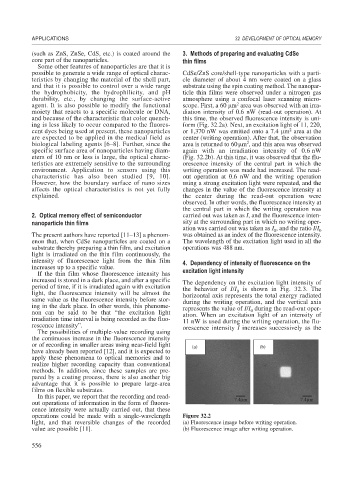
                  biological labeling agents [6–8]. Further, since the  area is returned to 60 m , and this area was observed
                  specific surface area of nanoparticles having diam-  again with an irradiation intensity of 0.6 nW
                  eters of 10 nm or less is large, the optical charac-  (Fig. 32.2b). At this time, it was observed that the flu-
                  teristics are extremely sensitive to the surrounding  orescence intensity of the central part in which the
                  environment.  Application to sensors using this  writing operation was made had increased. The read-
                  characteristic has also been studied [9, 10].  out operation at 0.6 nW and the writing operation
                  However, how the boundary surface of nano sizes  using a strong excitation light were repeated, and the
                  affects the optical characteristics is not yet fully  changes in the value of the fluorescence intensity at
                  explained.                                     the center during the read-out operation were
                                                                 observed. In other words, the fluorescence intensity at
                                                                 the central part in which the writing operation was
                  2. Optical memory effect of semiconductor      carried out was taken as I, and the fluorescence inten-
                  nanoparticle thin films                        sity at the surrounding part in which no writing oper-
                                                                 ation was carried out was taken as I , and the ratio I/I 0
                                                                                             0
                  The present authors have reported [11–13] a phenom-  was obtained as an index of the fluorescence intensity.
                  enon that, when CdSe nanoparticles are coated on a  The wavelength of the excitation light used in all the
                  substrate thereby preparing a thin film, and excitation  operations was 488 nm.
                  light is irradiated on the thin film continuously, the
                  intensity of fluorescence light from the thin film  4. Dependency of intensity of fluorescence on the
                  increases up to a specific value.
                    If the thin film whose fluorescence intensity has  excitation light intensity
                  increased is stored in a dark place, and after a specific  The dependency on the excitation light intensity of
                  period of time, if it is irradiated again with excitation  the behavior of  I/I is shown in Fig. 32.3.  The
                                                                                 0
                  light, the fluorescence intensity will be almost the  horizontal axis represents the total energy radiated
                  same value as the fluorescence intensity before stor-  during the writing operation, and the vertical axis
                  ing in the dark place. In other words, this phenome-  represents the value of I/I during the read-out oper-
                                                                                      0
                  non can be said to be that “the excitation light  ation.  When an excitation light of an intensity of
                  irradiation time interval is being recorded as the fluo-  11 nW is used during the writing operation, the flu-
                  rescence intensity”.                           orescence intensity  I increases successively as the
                    The possibilities of multiple-value recording using
                  the continuous increase in the fluorescence intensity
                  or of recording in smaller areas using near-field light  (a)          (b)
                  have already been reported [12], and it is expected to
                  apply these phenomena to optical memories and to
                  realize higher recording capacity than conventional
                  methods. In addition, since these samples are pre-
                  pared by a coating process, there is also another big
                  advantage that it is possible to prepare large-area
                  films on flexible substrates.
                    In this paper, we report that the recording and read-
                  out operations of information in the form of fluores-         7.4μm                7.4μm
                  cence intensity were actually carried out, that these
                  operations could be made with a single-wavelength  Figure 32.2
                  light, and that reversible changes of the recorded  (a) Fluorescence image before writing operation.
                  value are possible [11].                       (b) Fluorescence image after writing operation.

                  556

