


Page 581 - Book Hosokawa Nanoparticle Technology Handbook
P. 581
31 DEVELOPMENT OF EXHAUST CATALYST                                            APPLICATIONS


                                 (a)          (b)                (c)                    (d)
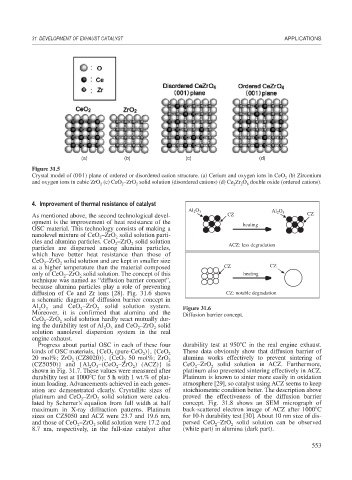
                  Figure 31.5
                  Crystal model of (001) plane of ordered or disordered cation structure. (a) Cerium and oxygen ions in CeO (b) Zirconium
                                                                                                2
                  and oxygen ions in cubic ZrO (c) CeO –ZrO solid solution (disordered cations) (d) Ce Zr O double oxide (ordered cations).
                                              2
                                                  2
                                       2
                                                                                2
                                                                                  2
                                                                                    8
                  4. Improvement of thermal resistance of catalyst
                                                                  Al O                      Al O
                                                                    2 3
                                                                                              2 3
                  As mentioned above, the second technological devel-         CZ                       CZ
                  opment is the improvement of heat resistance of the              heating
                  OSC material. This technology consists of making a
                  nanolevel mixture of CeO –ZrO solid solution parti-
                                            2
                                       2
                  cles and alumina particles. CeO –ZrO solid solution          ACZ: less degradation
                                                 2
                                            2
                  particles are dispersed among alumina particles,
                  which have better heat resistance than those of
                  CeO –ZrO solid solution and are kept in smaller size
                      2
                           2
                  at a higher temperature than the material composed         CZ             CZ
                  only of CeO –ZrO solid solution. The concept of this             heating
                                 2
                            2
                  technique was named as “diffusion barrier concept”,
                  because alumina particles play a role of preventing
                  diffusion of Ce and Zr ions [28]. Fig. 31.6 shows           CZ: notable degradation
                  a schematic diagram of diffusion barrier concept in
                  Al O 3  and CeO –ZrO 2  solid solution system.  Figure 31.6
                    2
                                 2
                  Moreover, it is confirmed that alumina and the  Diffusion barrier concept.
                  CeO –ZrO solid solution hardly react mutually dur-
                           2
                      2
                  ing the durability test of Al O and CeO –ZrO solid
                                                        2
                                                   2
                                          3
                                        2
                  solution nanolevel dispersion system in the real
                  engine exhaust.
                    Progress about partial OSC in each of these four  durability test at 950 C in the real engine exhaust.
                  kinds of OSC materials, {CeO (pure-CeO )}, {CeO 2  These data obviously show that diffusion barrier of
                                          2
                                                    2
                  20 mol%; ZrO (CZ8020)}, {CeO 50 mol%; ZrO 2    alumina works effectively to prevent sintering of
                              2
                                              2
                  (CZ5050)} and {Al O –(CeO –ZrO ) (ACZ)} is     CeO –ZrO solid solution in  ACZ. Furthermore,
                                                                         2
                                                                    2
                                    2
                                                 2
                                      3
                                            2
                  shown in Fig. 31.7. These values were measured after  platinum also prevented sintering effectively in ACZ.
                  durability test at 1000 C for 5 h with 1 wt.% of plat-  Platinum is known to sinter more easily in oxidation
                  inum loading. Advancements achieved in each gener-  atmosphere [29], so catalyst using ACZ seems to keep
                  ation are demonstrated clearly. Crystallite sizes of  stoichiometric condition better. The description above
                  platinum and CeO –ZrO solid solution were calcu-  proved the effectiveness of the diffusion barrier
                                 2
                                      2
                  lated by Scherrer’s equation from full width at half  concept. Fig. 31.8 shows an SEM micrograph of
                  maximum in X-ray diffraction patterns. Platinum  back-scattered electron image of ACZ after 1000 C
                  sizes on CZ5050 and ACZ were 23.7 and 19.6 nm,  for 10-h durability test [30]. About 10 nm size of dis-
                  and those of CeO –ZrO solid solution were 17.2 and  persed CeO –ZrO solid solution can be observed
                                                                           2
                                                                               2
                                2
                                     2
                  8.7 nm, respectively, in the full-size catalyst after  (white part) in alumina (dark part).
                                                                                                        553

