


Page 585 - Book Hosokawa Nanoparticle Technology Handbook
P. 585
32 DEVELOPMENT OF OPTICAL MEMORY                                              APPLICATIONS

                       4                                           3.5
                     3.5
                                                                     3
                       3
                                                                   2.5
                     2.5
                                                                     2
                    I/I o  2                                      I/I 0
                                                                   1.5
                     1.5
                       1          Result of writing with an intensity of 11 nW  1
                                  Result of writing with an intensity of 220 nW
                     0.5                                           0.5        Result of writing with an intensity of 11nW
                                  Result of writing with an intensity of 1370 nW
                                                                              Result of writing with an intensity of 1370 nW
                       0
                        0       200     400      600      800        0
                       Total energy radiated during the writing operation (nJ)  0   1000  2000  3000  4000  5000
                                                                     Total energy radiated during the writing operation (nJ)
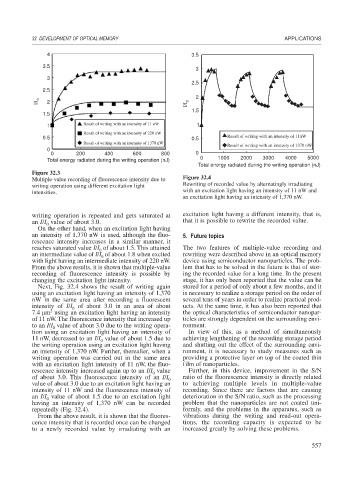
                  Figure 32.3
                  Multiple-value recording of fluorescence intensity due to  Figure 32.4
                  writing operation using different excitation light  Rewriting of recorded value by alternatingly irradiating
                  intensities.                                   with an excitation light having an intensity of 11 nW and
                                                                 an excitation light having an intensity of 1,370 nW.


                  writing operation is repeated and gets saturated at  excitation light having a different intensity, that is,
                  an I/I value of about 3.0.                     that it is possible to rewrite the recorded value.
                      0
                    On the other hand, when an excitation light having
                  an intensity of 1,370 nW is used, although the fluo-  5. Future topics
                  rescence intensity increases in a similar manner, it
                  reaches saturated value I/I of about 1.5. This attained  The two features of multiple-value recording and
                                       0
                  an intermediate value of I/I of about 1.8 when excited  rewriting were described above in an optical memory
                                       0
                  with light having an intermediate intensity of 220 nW.  device using semiconductor nanoparticles. The prob-
                  From the above results, it is shown that multiple-value  lem that has to be solved in the future is that of stor-
                  recording of fluorescence intensity is possible by  ing the recorded value for a long time. In the present
                  changing the excitation light intensity.       stage, it has only been reported that the value can be
                    Next, Fig. 32.4 shows the result of writing again  stored for a period of only about a few months, and it
                  using an excitation light having an intensity of 1,370  is necessary to realize a storage period on the order of
                  nW in the same area after recording a fluorescent  several tens of years in order to realize practical prod-
                  intensity of  I/I of about 3.0 in an area of about  ucts. At the same time, it has also been reported that
                              0
                        2
                  7.4  m using an excitation light having an intensity  the optical characteristics of semiconductor nanopar-
                  of 11 nW. The fluorescence intensity that increased up  ticles are strongly dependent on the surrounding envi-
                  to an I/I value of about 3.0 due to the writing opera-  ronment.
                        0
                  tion using an excitation light having an intensity of  In view of this, as a method of simultaneously
                  11 nW, decreased to an I/I value of about 1.5 due to  achieving lengthening of the recording storage period
                                       0
                  the writing operation using an excitation light having  and shutting out the effect of the surrounding envi-
                  an intensity of 1,370 nW. Further, thereafter, when a  ronment, it is necessary to study measures such as
                  writing operation was carried out in the same area  providing a protective layer on top of the coated thin
                  with an excitation light intensity of 11 nW, the fluo-  film of nanoparticles.
                  rescence intensity increased again up to an I/I value  Further, in this device, improvement in the S/N
                                                       0
                  of about 3.0.  This fluorescence intensity of an I/I  ratio of the fluorescence intensity is directly related
                                                            0
                  value of about 3.0 due to an excitation light having an  to achieving multiple levels in multiple-value
                  intensity of 11 nW and the fluorescence intensity of  recording. Since there are factors that are causing
                  an I/I value of about 1.5 due to an excitation light  deterioration in the S/N ratio, such as the processing
                      0
                  having an intensity of 1,370 nW can be recorded  problem that the nanoparticles are not coated uni-
                  repeatedly (Fig. 32.4).                        formly, and the problems in the apparatus, such as
                    From the above result, it is shown that the fluores-  vibrations during the writing and read-out opera-
                  cence intensity that is recorded once can be changed  tions, the recording capacity is expected to be
                  to a newly recorded value by irradiating with an  increased greatly by solving these problems.
                                                                                                        557

