


Page 590 - Book Hosokawa Nanoparticle Technology Handbook
P. 590
APPLICATIONS                                                   34 DEVELOPMENT OF PHOTOCATALYST
                            APPLICATION 34

                   34       DEVELOPMENT OF PHOTOCATALYST INSERTED INTO SURFACE OF POROUS
                            ALUMINOSILICATE


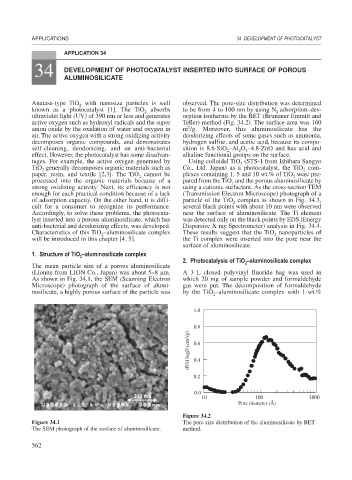
                  Anatase-type TiO with nanosize particles is well  observed. The pore-size distribution was determined
                                 2
                  known as a photocatalyst [1].  The  TiO absorbs  to be from 4 to 100 nm by using N adsorption–des-
                                                                                             2
                                                     2
                  ultraviolet light (UV) of 390 nm or less and generates  orption isotherms by the BET (Brunauer Emmitt and
                  active oxygen such as hydroxyl radicals and the super  Teller) method (Fig. 34.2). The surface area was 160
                                                                  2
                  anion oxide by the oxidation of water and oxygen in  m /g. Moreover, this aluminosilicate has the
                  air. The active oxygen with a strong oxidizing activity  deodorizing effects of some gases such as ammonia,
                  decomposes organic compounds, and demonstrates  hydrogen sulfite, and acetic acid, because its compo-
                  self-cleaning, deodorizing, and an anti-bacterial  sition is 8.6-SiO –Al O –4.8-ZnO and has acid and
                                                                              2
                                                                                    3
                                                                                  2
                  effect. However, the photocatalyst has some disadvan-  alkaline functional groups on the surface.
                  tages. For example, the active oxygen generated by  Using colloidal TiO (STS-1 from Ishihara Sangyo
                                                                                  2
                  TiO generally decomposes organic materials such as  Co., Ltd. Japan) as a photocatalyst, the TiO com-
                     2
                                                                                                      2
                  paper, resin, and textile [2,3].  The  TiO cannot be  plexes containing 1, 5 and 10 wt.% of TiO were pre-
                                                                                                   2
                                                   2
                  processed into the organic materials because of a  pared from the TiO and the porous aluminosilicate by
                                                                                2
                  strong oxidizing activity. Next, its efficiency is not  using a cationic surfactant. As the cross-section TEM
                  enough for each practical condition because of a lack  (Transmission Electron Microscope) photograph of a
                  of adsorption capacity. On the other hand, it is diffi-  particle of the TiO complex is shown in Fig. 34.3,
                                                                                2
                  cult for a consumer to recognize its performance.  several black points with about 10 nm were observed
                  Accordingly, to solve these problems, the photocata-  near the surface of aluminosilicate. The Ti element
                  lyst inserted into a porous aluminosilicate, which has  was detected only on the black points by EDS (Energy
                  anti-bacterial and deodorizing effects, was developed.  Dispersive X ray Spectrometer) analysis in Fig. 34.4.
                  Characteristics of this TiO –aluminosilicate complex  These results suggest that the TiO nanoparticles of
                                                                                             2
                                       2
                  will be introduced in this chapter [4, 5].     the Ti complex were inserted into the pore near the
                                                                 surface of aluminosilicate.
                  1. Structure of TiO –aluminosilicate complex
                                 2
                                                                 2. Photocatalysis of TiO –aluminosilicate complex
                                                                                    2
                  The mean particle size of a porous aluminosilicate
                  (Lionite from LION Co., Japan) was about 5–8  m.  A 3 L closed polyvinyl fluoride bag was used in
                  As shown in Fig. 34.1, the SEM (Scanning Electron  which 20 mg of sample powder and formaldehyde
                  Microscope) photograph of the surface of alumi-  gas were put. The decomposition of formaldehyde
                  nosilicate, a highly porous surface of the particle was  by the  TiO –aluminosilicate complex with 1-wt.%
                                                                          2
                                                                    1.0
                                                                    0.8
                                                                  dV/d logD (cm 3 /g)  0.6
                                                                    0.4
                                                                    0.2

                                                                    0.0
                                                 300 nm               10               100              1000
                                                                                  Pore diameter (Å)
                                                                 Figure 34.2
                  Figure 34.1                                    The pore size distribution of the aluminosilicate by BET
                  The SEM photograph of the surface of aluminosilicate.  method.

                  562

