


Page 583 - Book Hosokawa Nanoparticle Technology Handbook
P. 583
32 DEVELOPMENT OF OPTICAL MEMORY                                              APPLICATIONS
                            APPLICATION 32

                   32       DEVELOPMENT OF OPTICAL MEMORY USING SEMICONDUCTOR
                            NANOPARTICLES


                  While nanotechnology has been drawing a lot of  an organic phosphorus compound at a high temper-
                  attention in recent years, the “quantum size effect” is  ature.
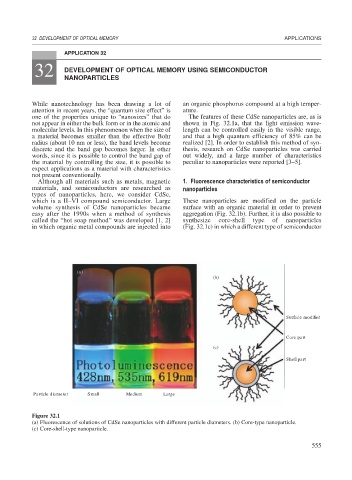
                  one of the properties unique to “nanosizes” that do  The features of these CdSe nanoparticles are, as is
                  not appear in either the bulk form or in the atomic and  shown in Fig. 32.1a, that the light emission wave-
                  molecular levels. In this phenomenon when the size of  length can be controlled easily in the visible range,
                  a material becomes smaller than the effective Bohr  and that a high quantum efficiency of 85% can be
                  radius (about 10 nm or less), the band levels become  realized [2]. In order to establish this method of syn-
                  discrete and the band gap becomes larger. In other  thesis, research on CdSe nanoparticles was carried
                  words, since it is possible to control the band gap of  out widely, and a large number of characteristics
                  the material by controlling the size, it is possible to  peculiar to nanoparticles were reported [3–5].
                  expect applications as a material with characteristics
                  not present conventionally.
                    Although all materials such as metals, magnetic  1. Fluorescence characteristics of semiconductor
                  materials, and semiconductors are researched as  nanoparticles
                  types of nanoparticles, here, we consider CdSe,
                  which is a II–VI compound semiconductor. Large  These nanoparticles are modified on the particle
                  volume synthesis of CdSe nanoparticles became  surface with an organic material in order to prevent
                  easy after the 1990s when a method of synthesis  aggregation (Fig. 32.1b). Further, it is also possible to
                  called the “hot soap method” was developed [1, 2]  synthesize core-shell type of nanoparticles
                  in which organic metal compounds are injected into  (Fig. 32.1c) in which a different type of semiconductor


                                (a)
                                                                          (b)


                                                                                                 Surface modifier

                                                                                                 Core part
                                                                          (c)

                                                                                                 Shell part


                  Particle diameter  Small     Medium      Large


                  Figure 32.1
                  (a) Fluorescence of solutions of CdSe nanoparticles with different particle diameters. (b) Core-type nanoparticle.
                  (c) Core-shell-type nanoparticle.

                                                                                                        555

