


Page 600 - Book Hosokawa Nanoparticle Technology Handbook
P. 600
APPLICATIONS                                36 DEVELOPMENT OF A HIGH-PERFORMANCE SECONDARY BATTERY
                  thickness covered the particles uniformly and was rel-  means of solving the aforementioned internal resist-
                  atively porous. Meanwhile, the dissolution of the  ance problem. In their method, CoO, Co(OH) or Co
                                                                                                      2
                  manganese from the alloy was limited to less than one  powders were added to the cathode.  These cobalt
                  tenth while no particular loss of discharge capacity  compounds were dissolved into the alkaline elec-
                  was observed. Consequently the Ni–PTFE composite  trolyte, whereupon the cathode was covered with
                  film works as an anticorrosive film and a catalyst to  Co(OH) . During the oxidation process (charge
                                                                       2
                  promote the redox reaction of hydrogen. It appears  process), this Co(OH) was converted to CoOOH,
                                                                                   2
                  important to design the nano structure of Ni–PTFE  which has high electric conductivity, allowing a very
                  composite film on the anode active material to  effective electron conduction path network to be pre-
                  improve the electrochemical properties of hydrogen  pared. Since CoOOH is stable within the potential
                  storage.                                       range where Ni(OH) works as a cathode, this net-
                                                                                  2
                                                                 work is retained during the charge/discharge process.
                                                                 A usage rate of 95% for the cathode active material
                  2. Cathode of the nickel hydrogen battery
                                                                 was achieved by this method, as shown in Fig. 36.3
                  As shown in the previous section, the cathode of the  [5,6]. Meanwhile, trials to obtain the improved elec-
                  nickel hydrogen battery is nickel hydroxide,   tron conduction network remain ongoing with vari-
                  Ni(OH) . During the charge process, Ni(OH) is con-  ous methods used.
                                                      2
                        2
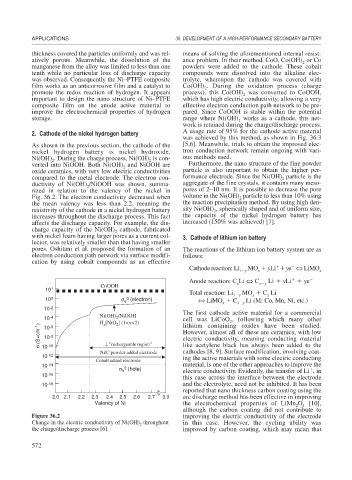
                  verted into NiOOH. Both Ni(OH) and NiOOH are    Furthermore, the nano structure of the fine powder
                                              2
                  oxide ceramics, with very low electric conductivities  particle is also important to obtain the higher per-
                  compared to the metal electrode. The electron con-  formance electrode. Since the Ni(OH) particle is the
                                                                                               2
                  ductivity of Ni(OH) /NiOOH was shown, summa-   aggregate of the fine crystals, it contains many meso-
                                   2
                  rized in relation to the valency of the nickel in  pores of 2–10 nm. It is possible to decrease the pore
                  Fig. 36.2. The electron conductivity decreased when  volume in the Ni(OH) particle to less than 10% using
                                                                                  2
                  the mean valency was less than 2.2, meaning the  the reaction precipitation method. By using high den-
                  resistivity of the cathode in a nickel hydrogen battery  sity Ni(OH) , spherically shaped and of uniform size,
                                                                          2
                  increases throughout the discharge process. This fact  the capacity of the nickel hydrogen battery has
                  affects the discharge capacity. For example, the dis-  increased (150% was achieved) [7].
                  charge capacity of the Ni(OH) cathode, fabricated
                                            2
                  with nickel foam having larger pores as a current col-  3. Cathode of lithium ion battery
                  lector, was relatively smaller than that having smaller
                  pores. Oshitani et al. proposed the formation of an  The reactions of the lithium ion battery system are as
                  electron conduction path network via surface modifi-  follows:
                  cation by using cobalt compounds as an effective


                                                                   Cathode reaction: Li 1 y MO   yLi  ye ⇔ LiMO x
                                                                                        x

                                                                   Anode reaction: C Li ⇔ C x y  Li   yLi   ye
                                                                                 x
                                       CoOOH
                      10 1
                                                                   Total reaction: Li 1 y  MO   C Li
                                                                                           x
                                                                                      x
                                               0
                      10 0                   σ  (electron)           ⇔ LiMO   C  x y  Li (M: Co, Mn, Ni, etc.)
                                              e
                                                                             x
                      10 -2
                                                                 The first cathode active material for a commercial
                                       Ni(OH) /NiOOH
                      10 -4                 2                    cell was LiCoO , following which many other
                                                                               2
                                       H [NiO ] (1<x<2)          lithium containing oxides have been studied.
                                            2
                    σ (S•cm -1 )  10 -8  ↓   rechargeable region”  However, almost all of these are ceramics, with low
                                        x
                       -6
                      10
                                                                 electric conductivity, meaning conducting material
                                          ”
                       -10
                     10
                                                                 cathodes [8, 9]. Surface modification, involving coat-
                                       Ni/C powder added electrode  like acetylene black has always been added to the
                     10 -12                                      ing the active materials with some electric conducting
                                      Cobalt added electrode
                     10 -14                                      material, is one of the other approaches to improve the
                                             σ  (hole)           electric conductivity. Evidently, the transfer of Li , in
                                              0

                                              h
                     10 -16
                                                                 this case across the interface between the electrode
                     10 -18                                      and the electrolyte, need not be inhibited. It has been
                                                                 reported that nano thickness carbon coating using the
                        2.0  2.1  2.2  2.3  2.4  2.5  2.6  2.7  3.0  arc discharge method has been effective in improving
                                     Valency of Ni               the electrochemical properties of LiMn O [10],
                                                                                                   2
                                                                                                      4
                                                                 although the carbon coating did not contribute to
                  Figure 36.2                                    improving the electric conductivity of the electrode
                  Change in the electric conductivity of Ni(OH) throughout  in this case. However, the cycling ability was
                                                   2
                  the charge/discharge process [6].              improved by carbon coating, which may mean that
                  572

