


Page 602 - Book Hosokawa Nanoparticle Technology Handbook
P. 602
APPLICATIONS                                36 DEVELOPMENT OF A HIGH-PERFORMANCE SECONDARY BATTERY
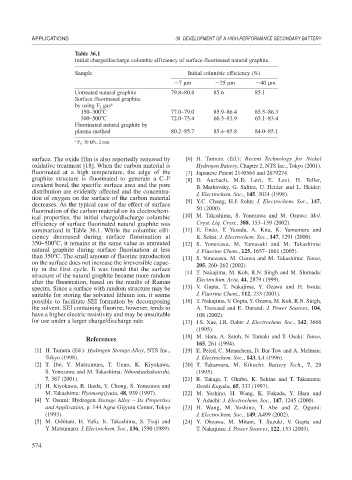
                               Table 36.1
                               Initial charge/discharge columbic efficiency of surface fluorinated natural graphite.
                               Sample                             Initial columbic efficiency (%)
                                                               7  m         25  m       40  m
                               Untreated natural graphite    79.8–80.8    85.6         85.1
                               Surface fluorinated graphite
                               by using F gas a
                                       2
                                 150–300 C                   77.0–79.0    85.9–86.4    85.5–86.3
                                 300–500 C                   72.0–75.4    66.5–83.9    65.1–83.4
                               Fluorinated natural graphite by
                               plasma method                 80.2–85.7    85.4–85.8    84.0–85.1
                               a  F 2 : 30 kPa, 2 min.

                  surface. The oxide film is also reportedly removed by  [6] H. Tamura  (Ed.):  Recent  Technology for Nickel
                  oxidative treatment [18]. When the carbon material is  Hydrogen Battery, Chapter 2, NTS Inc., Tokyo (2001).
                  fluorinated at a high temperature, the edge of the  [7] Japanese Patent 2140564 and 2679274.
                  graphite structure is fluorinated to generate a C–F  [8] D.  Aurbach, M.D. Levi, E. Levi, H.  Teller,
                  covalent bond, the specific surface area and the pore  B. Markovsky, G. Salitra, U. Heider and L. Heider:
                  distribution are evidently affected and the concentra-  J. Electrochem. Soc., 145, 3024 (1998).
                  tion of oxygen on the surface of the carbon material  [9] Y.C. Chang, H.J. Sohn:  J. Electrochem. Soc.,  147,
                  decreases. As the typical case of the effect of surface
                  fluorination of the carbon material on its electrochem-  50 (2000).
                  ical properties, the initial charge/discharge columbic  [10] M.  Takashima, S.  Yonezawa and M. Ozawa:  Mol.
                  efficiency of surface fluorinated natural graphite was  Cryst. Liq. Cryst., 388, 153–159 (2002).
                  summarized in Table 36.1. While the columbic effi-  [11] E. Endo,  T.  Yasuda,  A. Kita, K.  Yamamura and
                  ciency decreased during surface fluorination at    K. Sekai: J. Electrochem. Soc., 147, 1291 (2000).
                  350–500 C, it remains at the same value as untreated  [12] S. Yonezawa, M.  Yamasaki and M.  Takashima:
                  natural graphite during surface fluorination at less  J. Fluorine Chem., 125, 1657–1661 (2005).
                  than 350 C. The small amount of fluorine introduction  [13] S. Yonezawa, M. Ozawa and M. Takashima:  Tanso,
                  on the surface does not increase the irreversible capac-  205, 260–262 (2002).
                  ity in the first cycle. It was found that the surface  [14 T. Nakajima, M. Koh, R.N. Singh and M. Shimada:
                  structure of the natural graphite became more random
                  after the fluorination, based on the results of Raman  Electrochim. Acta, 44, 2879 (1999).
                  spectra. Since a surface with random structure may be  [15] V. Gupta,  T. Nakajima,  Y. Ozawa and H. Iwata:
                  suitable for storing the solvated lithium ion, it seems  J. Fluorine Chem., 112, 233 (2001).
                  possible to facilitate SEI formation by decomposing  [16] T. Nakajima, V. Gupta, Y. Ozawa, M. Koh, R.N. Singh,
                  the solvent. SEI containing fluorine, however, tends to  A. Tressaud and E. Durand: J. Power Sources, 104,
                  have a higher electric resistivity and may be unsuitable  108 (2002).
                  for use under a larger charge/discharge rate.  [17] J.S. Xue, J.R. Dahn: J. Electrochem. Soc., 142, 3668
                                                                     (1995).
                                                                 [18] M. Hara, A. Satoh, N. Tamaki and T. Osaki: Tanso,
                                   References
                                                                     165, 261 (1994).
                   [1] H. Tamura (Ed.): Hydrogen Storage Alloy, NTS Inc.,  [19] E. Peled, C. Menachem, D. Bar-Tow and A. Melman:
                      Tokyo (1998).                                  J. Electrochem. Soc., 143, L4 (1996).
                   [2] T. Ibe,  Y. Matsumura,  T. Ueno, K. Kiyokawa,  [20] T.  Takamura, M. Kikuchi:  Battery Tech.,  7, 29
                      S. Yonezawa and M. Takashima: Nihonkaakukaioshi,  (1995).
                      7, 387 (2001).                             [21] R.  Takagi,  T. Okubo, K. Sekine and  T.  Takamura:
                   [3] H. Kiyokawa, R. Ikeda, Y. Chong, S. Yonezawa and  Denki Kagaku, 65, 333 (1997).
                      M. Takashima: Hyomengijyutu, 48, 939 (1997).  [22] M.  Yoshino, H.  Wang, K. Fukuda,  Y. Hara and
                   [4] Y. Osumi: Hydrogen Storage Alloy – Its Properties  Y. Adachi: J. Electrochem. Soc., 147, 1245 (2000).
                      and Application, p. 144 Agne Gijyutu Center, Tokyo  [23] H. Wang, M.  Yoshino,  T.  Abe and Z. Ogumi:
                      (1993).                                        J. Electrochem. Soc., 149, A499 (2002).
                   [5] M. Oshitani, H.  Yufu, K.  Takashima, S.  Tsuji and  [24] Y. Ohzawa, M. Mitani,  T. Suzuki,  V. Gupta and
                      Y. Matsumaru: J. Electrochem. Soc., 136, 1590 (1989).  T. Nakajima: J. Power Sources, 122, 153 (2003).

                  574

