


Page 607 - Book Hosokawa Nanoparticle Technology Handbook
P. 607
38 EXPRESSION OF OPTICAL FUNCTION                                             APPLICATIONS


                                          2+ 5
                                               7
                                       Sm : Do- FJ
                            3+ 4
                                  6
                          Sm : G 5/2 - HJ  J=0
                                   9/2
                            7/2                2
                    Intensity (a.u.)  (b)   1
                      J=5/2


                       (a)                                       Figure 38.2
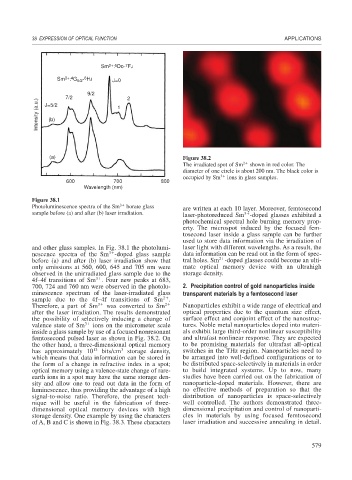
                                                                 The irradiated spot of Sm 2   shown in red color. The
                                                                 diameter of one circle is about 200 nm. The black color is
                                                                 occupied by Sm 3   ions in glass samples.
                            600            700            800
                                  Wavelength (nm)

                  Figure 38.1
                  Photoluminescence spectra of the Sm 3   borate glass  are written at each 10 layer. Moreover, femtosecond
                  sample before (a) and after (b) laser irradiation.                3
                                                                 laser-photoreduced Sm -doped glasses exhibited a
                                                                 photochemical spectral hole burning memory prop-
                                                                 erty.  The microspot induced by the focused fem-
                                                                 tosecond laser inside a glass sample can be further
                                                                 used to store data information via the irradiation of
                  and other glass samples. In Fig. 38.1 the photolumi-  laser light with different wavelengths. As a result, the
                                          3
                  nescence spectra of the Sm -doped glass sample  data information can be read out in the form of spec-
                                                                            2
                  before (a) and after (b) laser irradiation show that  tral holes. Sm -doped glasses could become an ulti-
                  only emissions at 560, 600, 645 and 705 nm were  mate optical memory device with an ultrahigh
                  observed in the unirradiated glass sample due to the  storage density.
                                      3
                  4f–4f transitions of Sm . Four new peaks at 683,
                  700, 724 and 760 nm were observed in the photolu-  2. Precipitation control of gold nanoparticles inside
                  minescence spectrum of the laser-irradiated glass  transparent materials by a femtosecond laser
                                                          2
                  sample due to the 4f–4f transitions of Sm .
                  Therefore, a part of Sm 3   was converted to Sm 2   Nanoparticles exhibit a wide range of electrical and
                  after the laser irradiation. The results demonstrated  optical properties due to the quantum size effect,
                  the possibility of selectively inducing a change of  surface effect and conjoint effect of the nanostruc-
                  valence state of Sm 3   ions on the micrometer scale  tures. Noble metal nanoparticles doped into materi-
                  inside a glass sample by use of a focused nonresonant  als exhibit large third-order nonlinear susceptibility
                  femtosecond pulsed laser as shown in Fig. 38.2. On  and ultrafast nonlinear response. They are expected
                  the other hand, a three-dimensional optical memory  to be promising materials for ultrafast all-optical
                                             3
                  has approximately 10 13  bits/cm storage density,  switches in the THz region. Nanoparticles need to
                  which means that data information can be stored in  be arranged into well-defined configurations or to
                  the form of a change in refractive index in a spot;  be distributed space-selectively in materials in order
                  optical memory using a valence-state change of rare-  to build integrated systems. Up to now, many
                  earth ions in a spot may have the same storage den-  studies have been carried out on the fabrication of
                  sity and allow one to read out data in the form of  nanoparticle-doped materials. However, there are
                  luminescence, thus providing the advantage of a high  no effective methods of preparation so that the
                  signal-to-noise ratio.  Therefore, the present tech-  distribution of nanoparticles is space-selectively
                  nique will be useful in the fabrication of three-  well controlled.  The authors demonstrated three-
                  dimensional optical memory devices with high   dimensional precipitation and control of nanoparti-
                  storage density. One example by using the characters  cles in materials by using focused femtosecond
                  of A, B and C is shown in Fig. 38.3. These characters  laser irradiation and successive annealing in detail.


                                                                                                        579

