


Page 609 - Book Hosokawa Nanoparticle Technology Handbook
P. 609
38 EXPRESSION OF OPTICAL FUNCTION                                             APPLICATIONS


                                                                     10000


                                                                   Intensity (a.u.)  5000


                                                                        0
                                                                              -1          0          1
                                                                                       Delay time (ps)
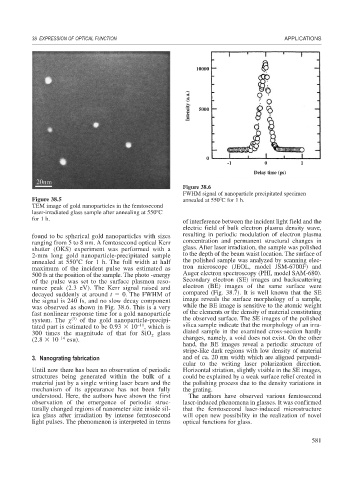
                                                                 Figure 38.6
                                                                 FWHM signal of nanoparticle precipitated specimen
                  Figure 38.5                                    annealed at 550 C for 1 h.
                  TEM image of gold nanoparticles in the femtosecond
                  laser-irradiated glass sample after annealing at 550 C
                  for 1 h.
                                                                 of interference between the incident light field and the
                                                                 electric field of bulk electron plasma density wave,
                  found to be spherical gold nanoparticles with sizes  resulting in periodic modulation of electron plasma
                  ranging from 5 to 8 nm. A femtosecond optical Kerr  concentration and permanent structural changes in
                  shutter (OKS) experiment was performed with a   glass. After laser irradiation, the sample was polished
                  2-mm long gold nanoparticle-precipitated sample  to the depth of the beam waist location. The surface of
                  annealed at 550 C for 1 h. The full width at half  the polished sample was analyzed by scanning elec-
                  maximum of the incident pulse was estimated as  tron microscope (JEOL, model JSM-6700F) and
                  500 fs at the position of the sample. The photo -energy  Auger electron spectroscopy (PHI, model SAM-680).
                  of the pulse was set to the surface plasmon reso-  Secondary electron (SE) images and backscattering
                  nance peak (2.3 eV).  The Kerr signal raised and  electron (BE) images of the same surface were
                  decayed suddenly at around t   0. The FWHM of  compared (Fig. 38.7). It is well known that the SE
                  the signal is 240 fs, and no slow decay component  image reveals the surface morphology of a sample,
                  was observed as shown in Fig. 38.6. This is a very  while the BE image is sensitive to the atomic weight
                  fast nonlinear response time for a gold nanoparticle  of the elements or the density of material constituting
                  system. The    (3)  of the gold nanoparticle-precipi-  the observed surface. The SE images of the polished
                  tated part is estimated to be 0.93   10 –11 , which is  silica sample indicate that the morphology of an irra-
                  300 times the magnitude of that for SiO glass   diated sample in the examined cross-section hardly
                                                       2
                  (2.8   10 –14  esu).                           changes, namely, a void does not exist. On the other
                                                                 hand, the BE images reveal a periodic structure of
                                                                 stripe-like dark regions with low density of material
                  3. Nanograting fabrication                     and of ca. 20 nm width which are aligned perpendi-
                                                                 cular to the writing laser polarization direction.
                  Until now there has been no observation of periodic  Horizontal striation, slightly visible in the SE images,
                  structures being generated within the bulk of a  could be explained by a weak surface relief created in
                  material just by a single writing laser beam and the  the polishing process due to the density variations in
                  mechanism of its appearance has not been fully  the grating.
                  understood. Here, the authors have shown the first  The authors have observed various femtosecond
                  observation of the emergence of periodic struc-  laser-induced phenomena in glasses. It was confirmed
                  turally changed regions of nanometer size inside sil-  that the femtosecond laser-induced microstructure
                  ica glass after irradiation by intense femtosecond  will open new possibility in the realization of novel
                  light pulses. The phenomenon is interpreted in terms  optical functions for glass.

                                                                                                        581

