


Page 613 - Book Hosokawa Nanoparticle Technology Handbook
P. 613
39 INSTANTANEOUS NANOFOAMING METHOD FOR FABRICATION OF CLOSED-POROSITY SILICA PARTICLE  APPLICATIONS

                                                                                             o
                               45                                                         950 C
                               40
                                                                                              o
                                                                                            900 C
                               35

                               30
                            V ad (cc(STP)/g sample )  25                                    850 C

                                                                                               o
                               20
                                                                                               o
                                                                                            800 C
                               15
                                                                                               o
                                                                                            750 C
                               10
                                                                                               o
                                                                                            700 C
                                5                                                              o
                                                                                            600 C
                                0
                                 0         0.2       0.4        0.6       0.8       1       500 C
                                                                                               o
                                                        P/P (−)
                                                           0
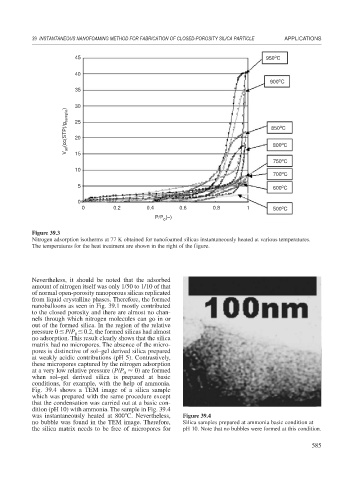
                  Figure 39.3
                  Nitrogen adsorption isotherms at 77 K obtained for nanofoamed silicas instantaneously heated at various temperatures.
                  The temperatures for the heat treatment are shown in the right of the figure.


                  Nevertheless, it should be noted that the adsorbed
                  amount of nitrogen itself was only 1/50 to 1/10 of that
                  of normal open-porosity nanoporous silicas replicated
                  from liquid crystalline phases. Therefore, the formed
                  nanoballoons as seen in Fig. 39.1 mostly contributed
                  to the closed porosity and there are almost no chan-
                  nels through which nitrogen molecules can go in or
                  out of the formed silica. In the region of the relative
                  pressure 0 P/P  0.2, the formed silicas had almost
                               0
                  no adsorption. This result clearly shows that the silica
                  matrix had no micropores. The absence of the micro-
                  pores is distinctive of sol–gel derived silica prepared
                  at weakly acidic contributions (pH 5). Contrastively,
                  these micropores captured by the nitrogen adsorption
                  at a very low relative pressure (P/P   0) are formed
                                              0
                  when sol–gel derived silica is prepared at basic
                  conditions, for example, with the help of ammonia.
                  Fig. 39.4 shows a  TEM image of a silica sample
                  which was prepared with the same procedure except
                  that the condensation was carried out at a basic con-
                  dition (pH 10) with ammonia. The sample in Fig. 39.4
                  was instantaneously heated at 800 C. Nevertheless,  Figure 39.4
                  no bubble was found in the TEM image. Therefore,  Silica samples prepared at ammonia basic condition at
                  the silica matrix needs to be free of micropores for  pH 10. Note that no bubbles were formed at this condition.

                                                                                                        585

