


Page 618 - Book Hosokawa Nanoparticle Technology Handbook
P. 618
APPLICATIONS                            40 EVALUATION AND APPLICATIONS OF DISPERSING CNT IN THE POLYMERS
                  4. Dispersion of composites and its evaluation

                  Although it was not necessary for nanomaterials, a
                  number of reports discussed the dispersion of com-
                  posite materials and investigated their particle mor-
                  phology and the composite properties using
                  transmission electron microscope (TEM) or scanning
                  electron microscope (SEM). However, most of them,
                  the pictures of TEM or SEM, were compared and
                  evaluated visually; but the dispersion state of com-
                  posites was not handled numerically. For quantita-
                  tively evaluating the dispersion state of composites, it
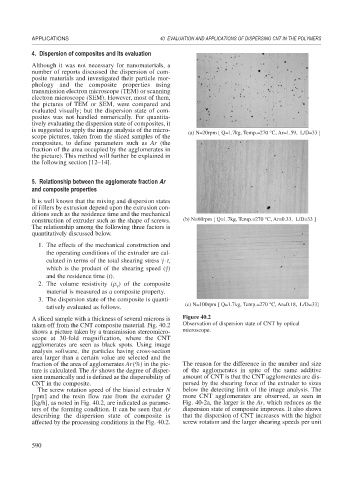
                  is suggested to apply the image analysis of the micro-  (a) N=20rpm [ Q=1.7kg, Temp.=270 °C, Ar=1.59,  L/D=33 ]
                  scope pictures, taken from the sliced samples of the
                  composites, to define parameters such as  Ar (the
                  fraction of the area occupied by the agglomerates in
                  the picture). This method will further be explained in
                  the following section [12–14].


                  5. Relationship between the agglomerate fraction Ar
                  and composite properties
                  It is well known that the mixing and dispersion states
                  of fillers by extrusion depend upon the extrusion con-
                  ditions such as the residence time and the mechanical
                  construction of extruder such as the shape of screws.  (b) N=60rpm [ Q=1.7kg, Temp.=270 °C, Ar=0.33,  L/D=33 ]
                  The relationship among the following three factors is
                  quantitatively discussed below.
                    1. The effects of the mechanical construction and
                      the operating conditions of the extruder are cal-
                                                          ·.
                      culated in terms of the total shearing stress   t,
                                                            ·
                      which is the product of the shearing speed ( )
                      and the residence time (t).
                    2. The volume resistivity (  ) of the composite
                                            v
                      material is measured as a composite property.
                    3. The dispersion state of the composite is quanti-
                      tatively evaluated as follows.             (c) N=100rpm [ Q=1.7kg, Temp.=270 °C, Ar=0.18,  L/D=33]

                  A sliced sample with a thickness of several microns is  Figure 40.2
                  taken off from the CNT composite material. Fig. 40.2  Observation of dispersion state of CNT by optical
                  shows a picture taken by a transmission stereomicro-  microscope.
                  scope at 30-fold magnification, where the CNT
                  agglomerates are seen as black spots. Using image
                  analysis software, the particles having cross-section
                  area larger than a certain value are selected and the
                  fraction of the area of agglomerates Ar(%) in the pic-  The reason for the difference in the number and size
                  ture is calculated. The Ar shows the degree of disper-  of the agglomerates in spite of the same additive
                  sion numerically and is defined as the dispersibility of  amount of CNT is that the CNT agglomerates are dis-
                  CNT in the composite.                          persed by the shearing force of the extruder to sizes
                    The screw rotation speed of the biaxial extruder N  below the detecting limit of the image analysis. The
                  [rpm] and the resin flow rate from the extruder  Q  more CNT agglomerates are observed, as seen in
                  [kg/h], as noted in Fig. 40.2, are indicated as parame-  Fig. 40-2a, the larger is the Ar, which reduces as the
                  ters of the forming condition. It can be seen that Ar  dispersion state of composite improves. It also shows
                  describing the dispersion state of composite is  that the dispersion of CNT increases with the higher
                  affected by the processing conditions in the Fig. 40.2.  screw rotation and the larger shearing speeds per unit


                  590

