


Page 623 - Book Hosokawa Nanoparticle Technology Handbook
P. 623
41 SURFACE MODIFICATION OF INORGANIC NANOPARTICLES BY ORGANIC FUNCTIONAL GROUPS  APPLICATIONS
                  3. Hybridization of inorganic nanoparticles with  nanoparticles as shown in Fig. 41.4 [4]. In addition to
                  biomolecules                                   this work, we are trying to hybridize inorganic
                                                                 nanoparticles with enzymes and antibodies to realize
                  The synthesis of surface-modified inorganic nanopar-  various inorganic-bimolecular complexes.
                  ticles enables the use of inorganic nanoparticles in  In this chapter, we discussed the surface modifica-
                  various medical applications.  The surface-modified  tion of inorganic nanoparticles by organic functional
                  nanoparticles can bind with biomolecules as well as  groups. Recent development in the preparative meth-
                  inorganic materials.  The hybridized nanoparticles  ods of inorganic nanoparticles has opened the way to
                  have both inorganic properties and biological speci-  the application of the nanoparticles. The organic mod-
                  ficity. In this section, we discuss the alignment of  ification of the inorganic nanoparticles is the most
                  metal nanoparticles on a ladder structure of deoxyri-  suitable method to modify the surface properties
                  bonucleic acid (DNA) through hybridization between  including dispersion and hybridization of the
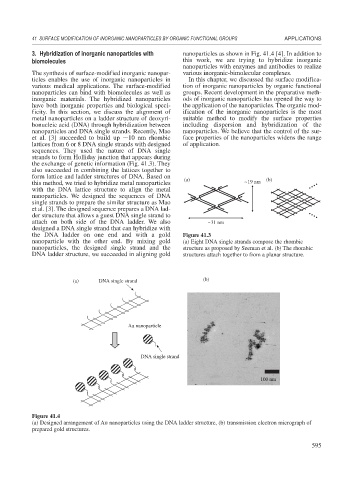
                  nanoparticles and DNA single strands. Recently, Mao  nanoparticles. We believe that the control of the sur-
                  et al. [3] succeeded to build up   10 nm rhombic  face properties of the nanoparticles widens the range
                  lattices from 6 or 8 DNA single strands with designed  of application.
                  sequences.  They used the nature of DNA single
                  strands to form Holliday junction that appears during
                  the exchange of genetic information (Fig. 41.3). They
                  also succeeded in combining the lattices together to
                  form lattice and ladder structures of DNA. Based on  (a)                (b)
                  this method, we tried to hybridize metal nanoparticles            ~19 nm
                  with the DNA lattice structure to align the metal
                  nanoparticles.  We designed the sequences of DNA
                  single strands to prepare the similar structure as Mao
                  et al. [3]. The designed sequence prepares a DNA lad-
                  der structure that allows a guest DNA single strand to
                  attach on both side of the DNA ladder.  We also       ~31 nm
                  designed a DNA single strand that can hybridize with
                  the DNA ladder on one end and with a gold      Figure 41.3
                  nanoparticle with the other end. By mixing gold  (a) Eight DNA single strands compose the rhombic
                  nanoparticles, the designed single strand and the  structure as proposed by Seeman et al. (b) The rhombic
                  DNA ladder structure, we succeeded in aligning gold  structures attach together to from a planar structure.


                               (a)     DNA single strand               (b)


                                                Au nanoparticle


                                                    DNA single strand


                                                                                         100 nm


                  Figure 41.4
                  (a) Designed arrangement of Au nanoparticles using the DNA ladder structure, (b) transmission electron micrograph of
                  prepared gold structures.

                                                                                                        595

