


Page 619 - Book Hosokawa Nanoparticle Technology Handbook
P. 619
40 EVALUATION AND APPLICATIONS OF DISPERSING CNT IN THE POLYMERS              APPLICATIONS
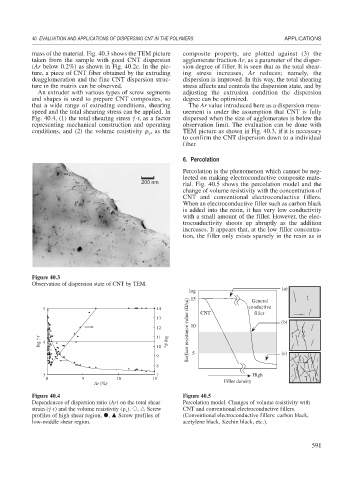
                  mass of the material. Fig. 40.3 shows the TEM picture  composite property, are plotted against (3) the
                  taken from the sample with good CNT dispersion  agglomerate fraction Ar, as a parameter of the disper-
                  (Ar below 0.2%) as shown in Fig. 40.2c. In the pic-  sion degree of filler. It is seen that as the total shear-
                  ture, a piece of CNT fiber obtained by the extruding  ing stress increases,  Ar reduces; namely, the
                  deagglomeration and the fine CNT dispersion struc-  dispersion is improved. In this way, the total shearing
                  ture in the matrix can be observed.            stress affects and controls the dispersion state, and by
                    An extruder with various types of screw segments  adjusting the extrusion condition the dispersion
                  and shapes is used to prepare CNT composites, so  degree can be optimized.
                  that  a wide range of  extruding conditions, shearing  The Ar value introduced here as a dispersion meas-
                  speed and the total shearing stress can be applied. In  urement is under the assumption that CNT is fully
                                                 ·.
                  Fig. 40.4, (1) the total shearing stress   t, as a factor  dispersed when the size of agglomerates is below the
                  representing mechanical construction and operating  observation limit. The evaluation can be done with
                  conditions, and (2) the volume resistivity   , as the  TEM picture as shown in Fig. 40.3, if it is necessary
                                                      v
                                                                 to confirm the CNT dispersion down to a individual
                                                                 fiber.
                                                                 6. Percolation
                                                                 Percolation is the phenomenon which cannot be neg-
                                                                 lected on making electroconductive composite mate-
                                                    200 nm       rial. Fig. 40.5 shows the percolation model and the
                                                                 change of volume resistivity with the concentration of
                                                                 CNT and conventional electroconductive fillers.
                                                                 When an electroconductive filler such as carbon black
                                                                 is added into the resin, it has very low conductivity
                                                                 with a small amount of the filler. However, the elec-
                                                                 troconductivity shoots up abruptly as the addition
                                                                 increases. It appears that, at the low filler concentra-
                                                                 tion, the filler only exists sparsely in the resin as in


                  Figure 40.3
                  Observation of dispersion state of CNT by TEM.
                                                                                               (a)
                                                                   log
                                                                   15
                                                                  Surface resistance value (Ω/sq)
                                                                                      General
                     5                                  14            CNT            conductive
                                                                                       filler
                                                        13                                     (b)
                                                        12         10
                    log  ·t  4                          10  log ρ v
                   .                                    11

                                                        9           5                          (c)
                                                        8
                     3                                  7                             High
                      0          5          10         15
                                     Ar (%)                                  Filler density
                  Figure 40.4                                    Figure 40.5
                  Dependences of dispersion ratio (Ar) on the total shear  Percolation model. Changes of volume resistivity with
                       ·
                  strain ( ·t) and the volume resistivity (  ).  ,   Screw  CNT and conventional electroconductive fillers.
                                               v
                  profiles of high shear region,  ,   Screw profiles of  (Conventional electroconductive fillers: carbon black,
                  low-middle shear region.                       acetylene black, Kechin black, etc.).

                                                                                                        591

