


Page 614 - Book Hosokawa Nanoparticle Technology Handbook
P. 614
APPLICATIONS         39 INSTANTANEOUS NANOFOAMING METHOD FOR FABRICATION OF CLOSED-POROSITY SILICA PARTICLE
                  triggering the ballooning phenomena.  The weakly  bromoform and ethanol, which are completely
                  acidic condition is required to form the nonporous sil-  miscible with each other. The range of the density
                  ica matrix which enables the generated vapor to cause  measurement was between 800 and 2,800 kg m  3  in
                  the nanoballooning on the instantaneous heat treat-  the present case. The transparent quartz crucible is
                  ment for the foaming. Another possible reason for the  obviously advantageous for the instantaneous heat
                  absence of the foamed structure in Fig. 39.4 is that the  transfer because radiation works more effectively par-
                  condensation of hydroxyl function had been termi-  ticularly at a higher temperature. The experimental
                  nated prior to the instantaneous heat treatment for the  result in Fig. 39.5 that the closed porosity was larger
                  foaming.  This is also quite likely to be the case  when the quartz crucible was used indicates that more
                  because the condensation of silanol is effectively cat-  closed balloons were formed when the heating took
                  alyzed by a basic condition. In this case, the silica  place more rapidly with the help of the heat transfer
                  matrix cannot yield vapor available for the foaming  by direct radiation. Furthermore, the maximum
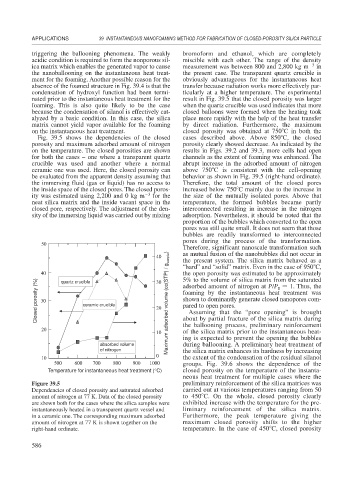
                  on the instantaneous heat treatment.           closed porosity was obtained at 750 C in both the
                    Fig. 39.5 shows the dependencies of the closed  cases described above.  Above 850 C, the closed
                  porosity and maximum adsorbed amount of nitrogen  porosity clearly showed decrease. As indicated by the
                  on the temperature. The closed porosities are shown  results in Figs. 39.2 and 39.3, more cells had open
                  for both the cases – one where a transparent quartz  channels as the extent of foaming was enhanced. The
                  crucible was used and another where a normal   abrupt increase in the adsorbed amount of nitrogen
                  ceramic one was used. Here, the closed porosity can  above 750 C is consistent with the cell-opening
                  be evaluated from the apparent density assuming that  behavior as shown in Fig. 39.5 (right-hand ordinate).
                  the immersing fluid (gas or liquid) has no access to  Therefore, the total amount of the closed pores
                  the inside space of the closed pores. The closed poros-  increased below 750 C mainly due to the increase in
                  ity was estimated using 2,200 and 0 kg m  3  for the  the size of the mutually isolated pores. Above that
                  neat silica matrix and the inside vacant space in the  temperature, the formed bubbles became partly
                  closed pore, respectively. The adjustment of the den-  interconnected resulting in increase in the nitrogen
                  sity of the immersing liquid was carried out by mixing  adsorption. Nevertheless, it should be noted that the
                                                                 proportion of the bubbles which converted to the open
                                                                 pores was still quite small. It does not seem that those
                                                                 bubbles are readily transformed to interconnected
                                                                 pores during the process of the transformation.
                     50
                                                                 Therefore, significant nanoscale transformation such
                                                        40       as mutual fusion of the nanobubbles did not occur in
                                                                 the present system. The silica matrix behaved as a
                     40    quartz crucible              30       “hard” and “solid” matrix. Even in the case of 950 C,
                                                                 the open porosity was estimated to be approximately
                                                                 5% to the volume of silica matrix from the saturated
                   Closed porosity (%)  30  ceramic crucible  20 Maximum adsorbed volume (cc(STP) / g sample )  foaming by the instantaneous heat treatment was
                                                                 adsorbed amount of nitrogen at P/P   1. Thus, the
                                                                                              0
                                                                 shown to dominantly generate closed nanopores com-
                                                                 pared to open pores.
                                                                  Assuming that the “pore opening” is brought
                                                                 the ballooning process, preliminary reinforcement
                     20                                          about by partial fracture of the silica matrix during
                                                        10       of the silica matrix prior to the instantaneous heat-
                                                                 during ballooning. A preliminary heat treatment of
                                       absorbed volume           ing is expected to prevent the opening the bubbles
                                       of nitrogen               the silica matrix enhances its hardness by increasing
                                                        0
                     10                                          the extent of the condensation of the residual silanol
                         500   600   700   800   900  1000       groups. Fig. 39.6 shows the dependence of the
                       Temperature for instantaneous heat treatment (°C)  closed porosity on the temperature of the instanta-
                                                                 neous heat treatment for multiple cases where the
                  Figure 39.5                                    preliminary reinforcement of the silica matrices was
                  Dependencies of closed porosity and saturated adsorbed  carried out at various temperatures ranging from 50
                  amount of nitrogen at 77 K. Data of the closed porosity  to 450 C. On the whole, closed porosity clearly
                  are shown both for the cases where the silica samples were  exhibited increase with the temperature for the pre-
                  instantaneously heated in a transparent quartz vessel and  liminary reinforcement of the silica matrix.
                  in a ceramic one. The corresponding maximum adsorbed  Furthermore, the peak temperature giving the
                  amount of nitrogen at 77 K is shown together on the  maximum closed porosity shifts to the higher
                  right-hand ordinate.                           temperature. In the case of 450 C, closed porosity

                  586

