


Page 615 - Book Hosokawa Nanoparticle Technology Handbook
P. 615
39 INSTANTANEOUS NANOFOAMING METHOD FOR FABRICATION OF CLOSED-POROSITY SILICA PARTICLE  APPLICATIONS
                                                                 showed that the preliminary reinforcement in the
                                              preheated at 450°C
                                                                 mechanical strength of the silica matrix by
                                                                 preheating significantly contributed to enhancing
                     65                                          the foaming without opening the formed nanobub-
                                                                 bles to the outer surface.  The maximum closed
                     60                           preheated at 350°C  porosity that was actually obtained in the author’s
                                                                 experiments was 64%, which was estimated from
                    Closed porosity (%)  55       preheated at 250°C  almost the same as that of neat ethanol at room tem-
                                                                                              3
                                                                 the apparent density of 790 kg m . This value is
                                                                 perature. Here, it should be noted that the amount of
                     50
                                                                 the bubbles also increases with the total extent of
                                                                 the reinforcement by the preheating. Thus, the supe-
                                                  preheated at 150°C
                                                                 riority in the mechanical strength of the silica
                    Cl
                     45
                                                                 matrix works more dominantly than the amount of
                                                  preheated at 50°C  the residual silanol groups which are directly
                     40   peak                                   responsible for generating water at the moment of
                                                                 the condensation.
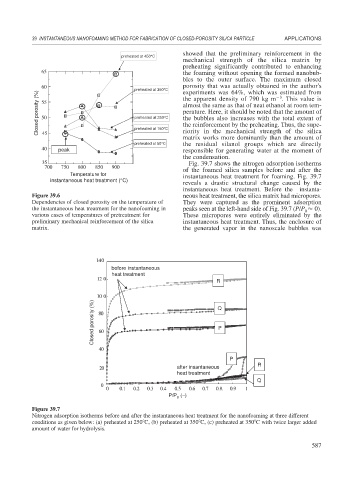
                     35                                           Fig. 39.7 shows the nitrogen adsorption isotherms
                      700  750  800  850   900
                                                                 of the foamed silica samples before and after the
                              Temperature for                    instantaneous heat treatment for foaming. Fig. 39.7
                        instantaneous heat treatment (°C)
                                                                 reveals a drastic structural change caused by the
                                                                 instantaneous heat treatment. Before the  instanta-
                  Figure 39.6                                    neous heat treatment, the silica matrix had micropores.
                  Dependencies of closed porosity on the temperature of  They were captured as the prominent adsorption
                  the instantaneous heat treatment for the nanofoaming in  peaks seen at the left-hand side of Fig. 39.7 (P/P   0).
                                                                                                      0
                  various cases of temperatures of pretreatment for  These micropores were entirely eliminated by the
                  preliminary mechanical reinforcement of the silica  instantaneous heat treatment. Thus, the enclosure of
                  matrix.                                        the generated vapor in the nanoscale bubbles was

                                      140
                                      14
                                           before instantaneous
                                           heat treatment
                                      12 0
                                                                           R R
                                      10 0                                 Q Q
                                     Closed porosity (%)  80 80            P P


                                       60


                                       40
                                                                               P P
                                       20                      after insantaneous      R R
                                                               heat treatment
                                                                                       Q Q
                                       0
                                         0   0. 0.1  0.2  0 0.3  0.4  0.5  0.6  0.7  0.8.  0.9  1
                                                            P/P  (−)
                                                               o
                  Figure 39.7
                  Nitrogen adsorption isotherms before and after the instantaneous heat treatment for the nanofoaming at three different
                  conditions as given below: (a) preheated at 250 C, (b) preheated at 350 C, (c) preheated at 350 C with twice larger added
                  amount of water for hydrolysis.

                                                                                                        587

