


Page 612 - Book Hosokawa Nanoparticle Technology Handbook
P. 612
APPLICATIONS         39 INSTANTANEOUS NANOFOAMING METHOD FOR FABRICATION OF CLOSED-POROSITY SILICA PARTICLE
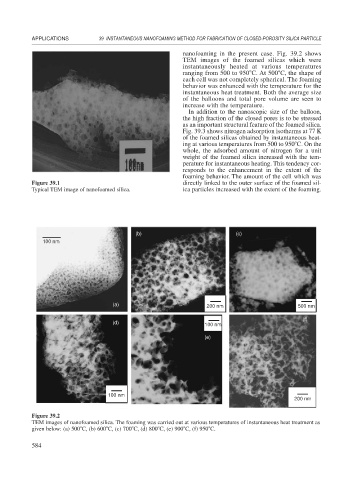
                                                                 nanofoaming in  the present case. Fig. 39.2 shows
                                                                 TEM images of the foamed silicas which were
                                                                 instantaneously heated at various temperatures
                                                                 ranging from 500 to 950 C. At 500 C, the shape of
                                                                 each cell was not completely spherical. The foaming
                                                                 behavior was enhanced with the temperature for the
                                                                 instantaneous heat treatment. Both the average size
                                                                 of the balloons and total pore volume are seen to
                                                                 increase with the temperature.
                                                                  In addition to the nanoscopic size of the balloon,
                                                                 the high fraction of the closed pores is to be stressed
                                                                 as an important structural feature of the foamed silica.
                                                                 Fig. 39.3 shows nitrogen adsorption isotherms at 77 K
                                                                 of the foamed silicas obtained by instantaneous heat-
                                                                 ing at various temperatures from 500 to 950 C. On the
                                                                 whole, the adsorbed amount of nitrogen for a unit
                                                                 weight of the foamed silica increased with the tem-
                                                                 perature for instantaneous heating. This tendency cor-
                                                                 responds to the enhancement in the extent of the
                                                                 foaming behavior. The amount of the cell which was
                  Figure 39.1                                    directly linked to the outer surface of the foamed sil-
                  Typical TEM image of nanofoamed silica.        ica particles increased with the extent of the foaming.


                                                  (b)                            (c)
                     100 nm


                                           (a)                          200 nm                      500 nm

                                                                                                      (f)
                                           (d)                         100 nm
                                                                       (e)


                                         100 nm
                                                                                                   200 nm

                  Figure 39.2
                  TEM images of nanofoamed silica. The foaming was carried out at various temperatures of instantaneous heat treatment as
                  given below: (a) 500 C, (b) 600 C, (c) 700 C, (d) 800 C, (e) 900 C, (f) 950 C.

                  584

