


Page 622 - Book Hosokawa Nanoparticle Technology Handbook
P. 622
APPLICATIONS              41 SURFACE MODIFICATION OF INORGANIC NANOPARTICLES BY ORGANIC FUNCTIONAL GROUPS
                  Table 41.1
                  Functions of metal oxides arranged by inputs and outputs.
                  Input\output  Photonic           Electronic          Magnet          Thermal   Chemical
                  Photonic     Luminescence        Photoconductivity   Photoinduced              Photo catalysis
                               Laser               Photovoltaic effect  magnet
                  Electronic   Light-emitting      Semiconductor       Magnetoelectric
                               devices                                 effect
                               Electro luminescence  Dielectrics

                  Magnetic     Faraday effect      Magnetic                            Magnetic
                                                   induction                           heating
                                                   Colossal magnetic
                                                   resistance
                  Thermal                          Piezoelectric       Magnetic phase
                                                   materials           transition
                  Chemical                         Fuel cell
                                                   Chemical sensor                               Catalysis


                     Hydrothermal synthesis
                      n+                      Metal oxide
                    M        M(OH) n     HO–  nanoparticle

                                                                  Organic phase
                                  Organic molecules
                                  (R-COOH, R-NH )
                                              2
                                                                   Water phase
                            Hybridization with
                             organic molecules  Organic-inorganic
                                                   hybridized                Iron oxide         Iron oxide
                                                                             nanoparticles      nanoparticles
                                                  nanoparticles
                                                                             synthesized without  synthesized with
                                                                             surface modifier   surface modifier
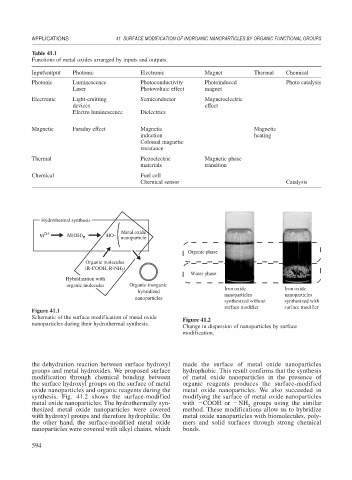
                  Figure 41.1
                  Schematic of the surface modification of metal oxide  Figure 41.2
                  nanoparticles during their hydrothermal synthesis.
                                                                 Change in dispersion of nanoparticles by surface
                                                                 modification.


                  the dehydration reaction between surface hydroxyl  made the surface of metal oxide nanoparticles
                  groups and metal hydroxides. We proposed surface  hydrophobic. This result confirms that the synthesis
                  modification through chemical bonding between  of metal oxide nanoparticles in the presence of
                  the surface hydroxyl groups on the surface of metal  organic reagents produces the surface-modified
                  oxide nanoparticles and organic reagents during the  metal oxide nanoparticles.  We also succeeded in
                  synthesis. Fig. 41.2 shows the surface-modified  modifying the surface of metal oxide nanoparticles
                  metal oxide nanoparticles. The hydrothermally syn-  with   COOH or   NH groups using the similar
                                                                                     2
                  thesized metal oxide nanoparticles were covered  method. These modifications allow us to hybridize
                  with hydroxyl groups and therefore hydrophilic. On  metal oxide nanoparticles with biomolecules, poly-
                  the other hand, the surface-modified metal oxide  mers and solid surfaces through strong chemical
                  nanoparticles were covered with alkyl chains, which  bonds.

                  594

