


Page 625 - Book Hosokawa Nanoparticle Technology Handbook
P. 625
42 FABRICATION TECHNIQUE OF ORGANIC NANOCRYSTALS                              APPLICATIONS


                                                R
                            R
                                                             N                 +
                                                                               N −
                                        hv or D
                            R                   R       R′              SO 3 −        C 60
                                      R′
                                                                    DAST

                                                                                  N       N
                                      R′                R′                            N  O
                               Monomer             Polymer                        N
                                                                                      Ti  N
                                                                                  N   N    N
                                                                   TPB

                                                   −                                TiOPc
                                     DCHD: R=R=     CH N
                                                   2
                                                                                         O
                                                                                 H
                                                                                 N               R
                                        Polydiacetylene
                                        derivatives                       R              N
                                                                                         H
                                                                                 O
                                                                 Perylene
                                                                               R = H or CH 3
                                                                               Quinacridone

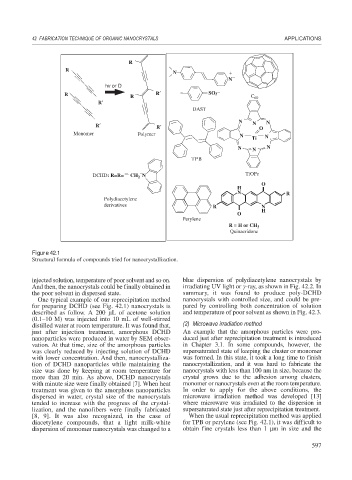
                  Figure 42.1
                  Structural formula of compounds tried for nanocrystallization.


                  injected solution, temperature of poor solvent and so on.  blue dispersion of polydiacetylene nanocrystals by
                  And then, the nanocrystals could be finally obtained in  irradiating UV light or  -ray, as shown in Fig. 42.2. In
                  the poor solvent in dispersed state.           summary, it was found to produce poly-DCHD
                    One typical example of our reprecipitation method  nanocrystals with controlled size, and could be pre-
                  for preparing DCHD (see Fig. 42.1) nanocrystals is  pared by controlling both concentration of solution
                  described as follow. A 200   L of acetone solution  and temperature of poor solvent as shown in Fig. 42.3.
                  (0.1–10 M) was injected into 10 mL of well-stirred
                  distilled water at room temperature. It was found that,  (2) Microwave irradiation method
                  just after injection treatment, amorphous DCHD  An example that the amorphous particles were pro-
                  nanoparticles were produced in water by SEM obser-  duced just after reprecipitation treatment is introduced
                  vation. At that time, size of the amorphous particles  in Chapter 3.1. In some compounds, however, the
                  was clearly reduced by injecting solution of DCHD  supersaturated state of keeping the cluster or monomer
                  with lower concentration. And then, nanocrystalliza-  was formed. In this state, it took a long time to finish
                  tion of DCHD nanoparticles while maintaining the  nanocrystallization, and it was hard to fabricate the
                  size was done by keeping at room temperature for  nanocrystals with less than 100 nm in size, because the
                  more than 20 min.  As above, DCHD nanocrystals  crystal grows due to the adhesion among clusters,
                  with minute size were finally obtained [7]. When heat  monomer or nanocrystals even at the room temperature.
                  treatment was given to the amorphous nanoparticles  In order to apply for the above conditions, the
                  dispersed in water, crystal size of the nanocrystals  microwave irradiation method was developed [13]
                  tended to increase with the progress of the crystal-  where microwave was irradiated to the dispersion in
                  lization, and the nanofibers were finally fabricated   supersaturated state just after reprecipitation treatment.
                  [8, 9]. It was also recognized, in the case of  When the usual reprecipitation method was applied
                  diacetylene compounds, that a light milk-white  for TPB or perylene (see Fig. 42.1), it was difficult to
                  dispersion of monomer nanocrystals was changed to a  obtain fine crystals less than 1   m in size and the

                                                                                                        597

