


Page 626 - Book Hosokawa Nanoparticle Technology Handbook
P. 626
APPLICATIONS                                      42 FABRICATION TECHNIQUE OF ORGANIC NANOCRYSTALS

                                    Solution of the target compound
                                                                         In the case of diacetylenes


                                                                    Solid-state
                                       Reprecipitation
                                                                    polymerization


                                                  Organic nanocrystals
                           Poor solvent                                  Polydiacetylene nanocrystals
                                                  dispersion
                           (water and so on)                             dispersion

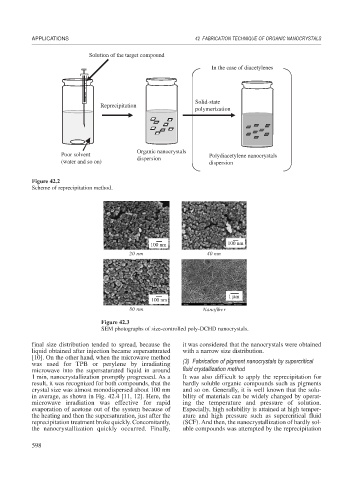
                  Figure 42.2
                  Scheme of reprecipitation method.


                                                       100 nm                 100 nm
                                                20 nm                   40 nm


                                                                               1 μm
                                                       100 nm
                                                80 nm                  Nanofiber
                                       Figure 42.3
                                       SEM photographs of size-controlled poly-DCHD nanocrystals.

                  final size distribution tended to spread, because the  it was considered that the nanocrystals were obtained
                  liquid obtained after injection became supersaturated  with a narrow size distribution.
                  [10]. On the other hand, when the microwave method
                  was used for  TPB or perylene by irradiating   (3) Fabrication of pigment nanocrystals by supercritical
                  microwave into the supersaturated liquid in around  fluid crystallization method
                  1 min, nanocrystallization promptly progressed. As a  It was also difficult to apply the reprecipitation for
                  result, it was recognized for both compounds, that the  hardly soluble organic compounds such as pigments
                  crystal size was almost monodispersed about 100 nm  and so on. Generally, it is well known that the solu-
                  in average, as shown in Fig. 42.4 [11, 12]. Here, the  bility of materials can be widely changed by operat-
                  microwave irradiation was effective for rapid  ing the temperature and pressure of solution.
                  evaporation of acetone out of the system because of  Especially, high solubility is attained at high temper-
                  the heating and then the supersaturation, just after the  ature and high pressure such as supercritical fluid
                  reprecipitation treatment broke quickly. Concomitantly,  (SCF). And then, the nanocrystallization of hardly sol-
                  the nanocrystallization  quickly occurred. Finally,  uble compounds was attempted by the reprecipitation

                  598

