


Page 148 - New Trends In Coal Conversion
P. 148
Coal and biomass cofiring: CFD modeling                            111


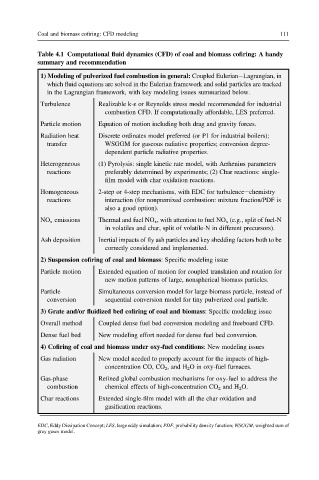
           Table 4.1 Computational fluid dynamics (CFD) of coal and biomass cofiring: A handy
           summary and recommendation
            1) Modeling of pulverized fuel combustion in general: Coupled EulerianeLagrangian, in
              which fluid equations are solved in the Eulerian framework and solid particles are tracked
              in the Lagrangian framework, with key modeling issues summarized below.
            Turbulence      Realizable k-ε or Reynolds stress model recommended for industrial
                             combustion CFD. If computationally affordable, LES preferred.
            Particle motion  Equation of motion including both drag and gravity forces.
            Radiation heat  Discrete ordinates model preferred (or P1 for industrial boilers);
              transfer       WSGGM for gaseous radiative properties; conversion degree-
                             dependent particle radiative properties.
            Heterogeneous   (1) Pyrolysis: single kinetic rate model, with Arrhenius parameters
              reactions      preferably determined by experiments; (2) Char reactions: single-
                             film model with char oxidation reactions.
            Homogeneous     2-step or 4-step mechanisms, with EDC for turbulenceechemistry
              reactions      interaction (for nonpremixed combustion: mixture fraction/PDF is
                             also a good option).
            NO x emissions  Thermal and fuel NO x , with attention to fuel NO x (e.g., split of fuel-N
                             in volatiles and char, split of volatile-N in different precursors).
            Ash deposition  Inertial impacts of fly ash particles and key shedding factors both to be
                             correctly considered and implemented.
            2) Suspension cofiring of coal and biomass: Specific modeling issue
            Particle motion  Extended equation of motion for coupled translation and rotation for
                             new motion patterns of large, nonspherical biomass particles.
            Particle        Simultaneous conversion model for large biomass particle, instead of
              conversion     sequential conversion model for tiny pulverized coal particle.
            3) Grate and/or fluidized bed cofiring of coal and biomass: Specific modeling issue
            Overall method  Coupled dense fuel bed conversion modeling and freeboard CFD.
            Dense fuel bed  New modeling effort needed for dense fuel bed conversion.
            4) Cofiring of coal and biomass under oxy-fuel conditions: New modeling issues
            Gas radiation   New model needed to properly account for the impacts of high-
                             concentration CO, CO 2 , and H 2 O in oxy-fuel furnaces.
            Gas-phase       Refined global combustion mechanisms for oxy-fuel to address the
              combustion     chemical effects of high-concentration CO 2 and H 2 O.
            Char reactions  Extended single-film model with all the char oxidation and
                             gasification reactions.


           EDC, Eddy Dissipation Concept; LES, large eddy simulation; PDF, probability density function; WSGGM, weighted sum of
           gray gases model.

