


Page 144 - New Trends In Coal Conversion
P. 144
Coal and biomass cofiring: CFD modeling                            107

           the freeboard in modern grate-fired boilers or fluidized bed combustors, the effect of
           the dense bed conversion models may be virtually restricted to the vicinity of the
           fuel bed.


           4.6   Coal and biomass cofiring under oxy-fuel conditions:
                 special modeling issues

           Oxy-fuel combustion has gained many concerns worldwide in the past years. More
           recently, oxy-fuel cofiring of coal and biomass also gains much attention, considering
           that a below-zero CO 2 emission may be achieved by combining the advantages of both
           oxy-fuel combustion and biomass cofiring. The use of CO 2 or the mixture of CO 2 and
           H 2 O vapor as the diluent in oxy-fuel combustion, instead of N 2 in air-fuel combustion,
           induces significant changes to the combustion fundamentals, particularly to radiative
           heat transfer and combustion chemistry, as reviewed in (Yin and Yan, 2016).
              Coal and biomass cofiring under oxy-fuel conditions has been numerically investi-

           gated in the literature, for example (Alvarez et al., 2013, 2014; Bhuiyan and Naser,
           2015, 2016; Black et al., 2013). The overall modeling strategy of oxy-fuel cofiring
           is the same as that of air-fuel cofiring. Although the majority of the impacts of the com-
           bustion atmospheres can be accommodated in modeling naturally, efforts are still
           needed to refine the existing models or mechanisms for radiative heat transfer and
           gas-phase combustion chemistry to make them applicable to oxy-fuel combustion
           (Yin and Yan, 2016).


           4.6.1  Modeling of gaseous radiative properties under oxy-fuel
                  conditions

           The radiative transfer equation to be solved under a typical solid fuel combustor is pre-
           sented in Eq. (4.2), in which the gas and particle radiative properties are evaluated by
           Eq. (4.3)e(4.5), respectively. The total gas emissivity of a local gas mixture to be used
           in Eq. (4.3), ε, is commonly evaluated by a WSGGM in combustion CFD because it is
           a good compromise between computational efficiency and accuracy. The WSGGM
           postulates that the total emissivity may be represented by the sum of the emissivities
           of several hypothetical gray gases and one clear gas, weighted by temperature-
           dependent factors (Hottel and Sarofim, 1967). In the model, each of the I gray gases
           has a constant pressure absorption coefficient k i , and the clear gas has k 0 ¼ 0.

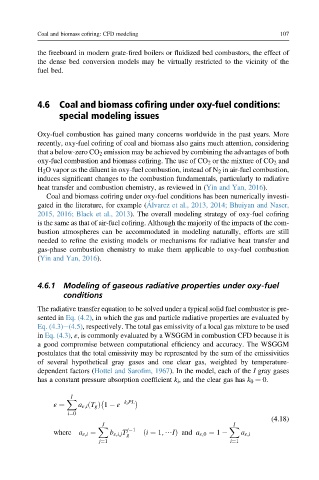
                    I
                   X              k i PL
               ε ¼    a ε;i ðT g Þ 1   e
                   i¼0
                                                                          (4.18)
                             J                                  I
                            X                                  X
               where  a ε;i ¼  b ε;i;j T g j 1  ði ¼ 1; /IÞ and a ε;0 ¼ 1    a ε;i
                            j¼1                                i¼1

