


Page 142 - New Trends In Coal Conversion
P. 142
Coal and biomass cofiring: CFD modeling                            105

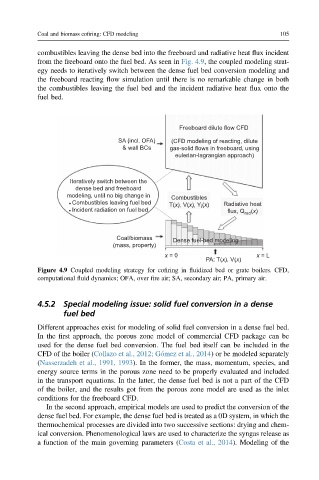
           combustibles leaving the dense bed into the freeboard and radiative heat flux incident
           from the freeboard onto the fuel bed. As seen in Fig. 4.9, the coupled modeling strat-
           egy needs to iteratively switch between the dense fuel bed conversion modeling and
           the freeboard reacting flow simulation until there is no remarkable change in both
           the combustibles leaving the fuel bed and the incident radiative heat flux onto the
           fuel bed.


                                                 Freeboard dilute flow CFD
                                 SA (incl. OFA)  (CFD modeling of reacting, dilute
                                  & wall BCs   gas-solid flows in freeboard, using
                                                eulerian-lagrangian approach)


                    Iteratively switch between the
                     dense bed and freeboard
                   modeling, until no big change in  Combustibles
                      ● Combustibles leaving fuel bed  T(x), V(x), Y (x)  Radiative heat
                                                       i
                    ● Incident radiation on fuel bed          flux, Q rad (x)


                                Coal/biomass    Dense fuel-bed modeling
                                (mass, property)
                                              x = 0                   x = L
                                                         PA: T(x), V(x)
           Figure 4.9 Coupled modeling strategy for cofiring in fluidized bed or grate boilers. CFD,
           computational fluid dynamics; OFA, over fire air; SA, secondary air; PA, primary air.


           4.5.2  Special modeling issue: solid fuel conversion in a dense
                  fuel bed

           Different approaches exist for modeling of solid fuel conversion in a dense fuel bed.
           In the first approach, the porous zone model of commercial CFD package can be
           used for the dense fuel bed conversion. The fuel bed itself can be included in the
           CFD of the boiler (Collazo et al., 2012; G  omez et al., 2014) or be modeled separately
           (Nasserzadeh et al., 1991, 1993). In the former, the mass, momentum, species, and
           energy source terms in the porous zone need to be properly evaluated and included
           in the transport equations. In the latter, the dense fuel bed is not a part of the CFD
           of the boiler, and the results got from the porous zone model are used as the inlet
           conditions for the freeboard CFD.
              In the second approach, empirical models are used to predict the conversion of the
           dense fuel bed. For example, the dense fuel bed is treated as a 0D system, in which the
           thermochemical processes are divided into two successive sections: drying and chem-
           ical conversion. Phenomenological laws are used to characterize the syngas release as
           a function of the main governing parameters (Costa et al., 2014). Modeling of the

