


Page 140 - New Trends In Coal Conversion
P. 140
Coal and biomass cofiring: CFD modeling                            103

              Such a model for tracking large, nonspherical particles in dilute two-phase flow is
           described in detail in (Yin et al., 2003). The model is validated by experiments before it
           is refined for biomass cofiring modeling (Yin et al., 2004). Here, a few results are given
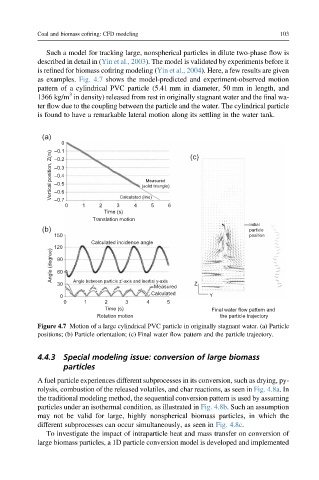
           as examples. Fig. 4.7 shows the model-predicted and experiment-observed motion
           pattern of a cylindrical PVC particle (5.41 mm in diameter, 50 mm in length, and
                    3
           1366 kg/m in density) released from rest in originally stagnant water and the final wa-
           ter flow due to the coupling between the particle and the water. The cylindrical particle
           is found to have a remarkable lateral motion along its settling in the water tank.


            (a)
                  0                                 (c)
                –0.1
               Vertical position, Z(m)  –0.3  (solid triangle)
                –0.2
                –0.4
                                        Measured
                –0.5
                –0.6
                –0.7
                   0   1    2    3 Calculated (line) 5  6
                                     4
                             Time (s)
                          Translation motion
                                                                    Initial
            (b)                                                     particle
                150                                                 position
                          Calculated incidence angle
               Angle (degree) 120
                90
                60
                30   Angle between particle z’-axis and inertial y-axis  Z
                                           Measured
                                          Calculated
                 0                                        Y
                  0     1    2     3     4    5
                             Time (s)                     Final water flow pattern and
                           Rotation motion                  the particle trajectory
           Figure 4.7 Motion of a large cylindrical PVC particle in originally stagnant water. (a) Particle
           positions; (b) Particle orientation; (c) Final water flow pattern and the particle trajectory.


           4.4.3  Special modeling issue: conversion of large biomass
                  particles

           A fuel particle experiences different subprocesses in its conversion, such as drying, py-
           rolysis, combustion of the released volatiles, and char reactions, as seen in Fig. 4.8a.In
           the traditional modeling method, the sequential conversion pattern is used by assuming
           particles under an isothermal condition, as illustrated in Fig. 4.8b. Such an assumption
           may not be valid for large, highly nonspherical biomass particles, in which the
           different subprocesses can occur simultaneously, as seen in Fig. 4.8c.
              To investigate the impact of intraparticle heat and mass transfer on conversion of
           large biomass particles, a 1D particle conversion model is developed and implemented

