


Page 141 - New Trends In Coal Conversion
P. 141
104                                            New Trends in Coal Conversion


         (a)                  (b)
             Moisture
                    Dry shell
                                Raw fuel   Dry fuel     Char       Ash
                    Wet core
                                      Inert      Volatile    Char       Inert
                                      heating    release    oxidation  heating

            TIME
                                              Sequential conversion model
                    Volatile flame
                      (visible)
                                                                        Ash
                              (c)                                       Char
                                                                        Dry fuel
                                                                        Raw fuel
                   Char oxidation
                   (no visible flame)        Simultaneous conversion model
            Particle conversion
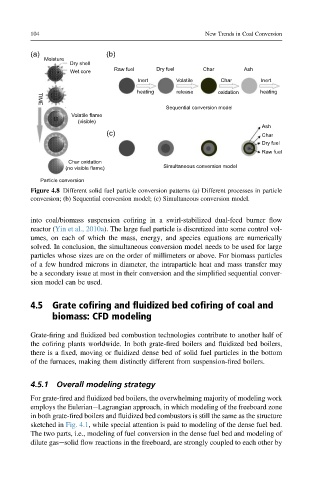
         Figure 4.8 Different solid fuel particle conversion patterns (a) Different processes in particle
         conversion; (b) Sequential conversion model; (c) Simultaneous conversion model.


         into coal/biomass suspension cofiring in a swirl-stabilized dual-feed burner flow
         reactor (Yin et al., 2010a). The large fuel particle is discretized into some control vol-
         umes, on each of which the mass, energy, and species equations are numerically
         solved. In conclusion, the simultaneous conversion model needs to be used for large
         particles whose sizes are on the order of millimeters or above. For biomass particles
         of a few hundred microns in diameter, the intraparticle heat and mass transfer may
         be a secondary issue at most in their conversion and the simplified sequential conver-
         sion model can be used.


         4.5   Grate cofiring and fluidized bed cofiring of coal and
               biomass: CFD modeling

         Grate-firing and fluidized bed combustion technologies contribute to another half of
         the cofiring plants worldwide. In both grate-fired boilers and fluidized bed boilers,
         there is a fixed, moving or fluidized dense bed of solid fuel particles in the bottom
         of the furnaces, making them distinctly different from suspension-fired boilers.


         4.5.1  Overall modeling strategy

         For grate-fired and fluidized bed boilers, the overwhelming majority of modeling work
         employs the EulerianeLagrangian approach, in which modeling of the freeboard zone
         in both grate-fired boilers and fluidized bed combustors is still the same as the structure
         sketched in Fig. 4.1, while special attention is paid to modeling of the dense fuel bed.
         The two parts, i.e., modeling of fuel conversion in the dense fuel bed and modeling of
         dilute gasesolid flow reactions in the freeboard, are strongly coupled to each other by

